Motorbike Insurance in Thailand for Foreigners: What Pays
Compulsory Por Ror Bor insurance pays set amounts per person, not repairs. On a rental, damage and a missing bike fall on the renter under the shop's conditions. A short-term third-party policy for renters pays up to THB 500,000 per person for injury to others. Travel cover differs by insurer, and both insurers read here name a valid motorbike licence.
On this page
Four kinds of cover sit behind a scooter in Thailand, and each pays for something different. The compulsory policy pays set amounts per person, not repairs.
The four layers of cover
| Layer | What it pays for | What it leaves out |
|---|---|---|
| Compulsory (Por Ror Bor) | Injury and death of people harmed by the vehicle | Damage to your own or third-party property |
| Voluntary classes 1, 2+, 3+, 2, 3 | Depends on the class: own-bike damage, theft, fire, flood, medical costs | Varies by class |
| Travel insurance | Emergency medical expenses overseas, if the activity and licence conditions are met | Theft or damage to the bike, and personal liability, in World Nomads’ wording |
| Short-term renter policy | Third-party injury and property, with own-bike repair as an option | Theft of the bike |
| Rental shop contract | Some shops list medical cover, such as THB 300,000 for the rider | Damage to the bike and a bike not returned fall on the renter |
The sections below start with the compulsory layer, then take the rental, travel and voluntary layers, then claim steps. The first hour after a crash is in Motorbike Accident in Chiang Mai: First Hour and Insurance.
Compulsory cover (Por Ror Bor): what it pays
Por Ror Bor is the compulsory policy under the Act, which makes the owner of a vehicle in use insure it for the benefit of accident victims. Nobody may use a vehicle without that insurance, subject to the exemptions in section 8. An owner who does not insure faces a fine of up to THB 10,000.
The owner or user must keep evidence of the insurance ready to show an officer, unless the vehicle has been registered or its annual tax paid under section 19.
A victim is anyone harmed in life, body or health by a vehicle in use or on the road, including a person in or on that vehicle. The Office of Insurance Commission (OIC) schedule sets the amounts.
| Cover | Amount |
|---|---|
| Injury or injury to health, per person | THB 80,000 |
| Death or total permanent disability, per person | THB 500,000 |
| Inpatient daily compensation | THB 200 a day, up to 20 days |
| Preliminary compensation for injury | Not more than THB 30,000 per person |
Preliminary compensation is a first payment made without waiting for fault to be proved, and it is part of the amounts above, not paid on top. If the victim is the driver of the insured vehicle, the policy covers only preliminary compensation. A renter riding the bike is its driver, so on the schedule’s wording the injury limit for the renter’s own hurt is the preliminary amount.
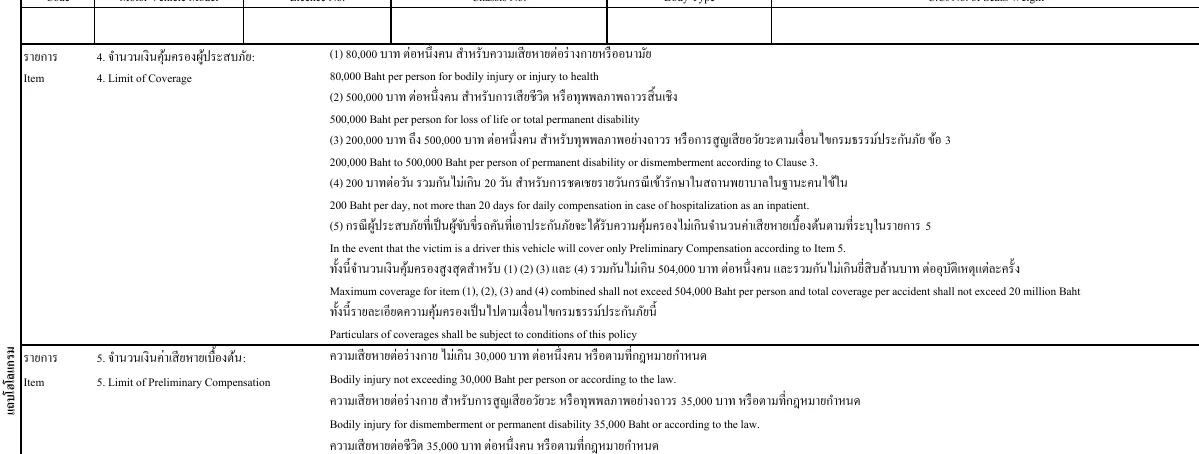
The compulsory policy gives no cover for damage to your own or third-party property. Repairs and a damaged rental bike need another layer.
When the vehicle had no insurance and its owner does not pay, the compensation fund pays the preliminary damages. The fund also pays when the driver fled or the vehicle cannot be identified.
Renting: whose cover applies
On a rental, the shop’s contract decides who pays. A shop’s own conditions say the renter becomes the temporary owner and answers for anything that happens with the bike. Damage on return is the renter’s repair bill, and after an accident it may exceed the deposit. A bike not returned costs the renter the price of a new one.
Cat Motors bases accident repair costs on catalogue prices for replacement parts and fair labour. It lists medical cover of up to THB 300,000 for the rider and the same for the passenger. Many hire companies have no insurance at all, and a renter could be responsible for costs tied to injury to others. Australian advice lists, for hiring a motorbike, that the hiring company has comprehensive and third-party insurance.
A short-term policy for the renter
A policy built for renters exists. CheckDi, a comparison seller, offers third-party cover of up to THB 500,000 per person for injury or death and THB 200,000 for third-party property. You pick the start and end dates, and you can buy after the bike is already rented. Premiums depend on rental length, engine size and passengers.
The bike itself is an optional extra: up to THB 8,000 for partial repair, and up to THB 12,000 per accident for a total loss, theft not included.
Theft is the open gap. World Nomads excludes theft or damage to a rented bike, the short-term policy excludes theft, and the shop contract makes the renter pay for a bike not returned. Take photos of the bike’s condition before you ride, because the repair bill is the renter’s.
Thai law adds a helmet duty for rider and passenger. Rental terms and deposits are in Motorbike Rental in Chiang Mai: Passport, Helmet, Licence.
What travel insurance says about scooters
Two insurers’ own pages are used here as examples. They are not a ranking, and another policy has its own wording. The World Nomads page was last updated on 2 July 2024.
World Nomads
The World Nomads policy has cover for riding a motorbike or moped or scooter under 125cc abroad, with the right activity chosen. It cannot cover motorbike touring or a motorbike as the main way of getting around, even for extra premium.
The activity must be added and paid for when the policy is bought, with no changes after it is issued. Policies bought before 27 June 2024 follow the wording received at purchase.
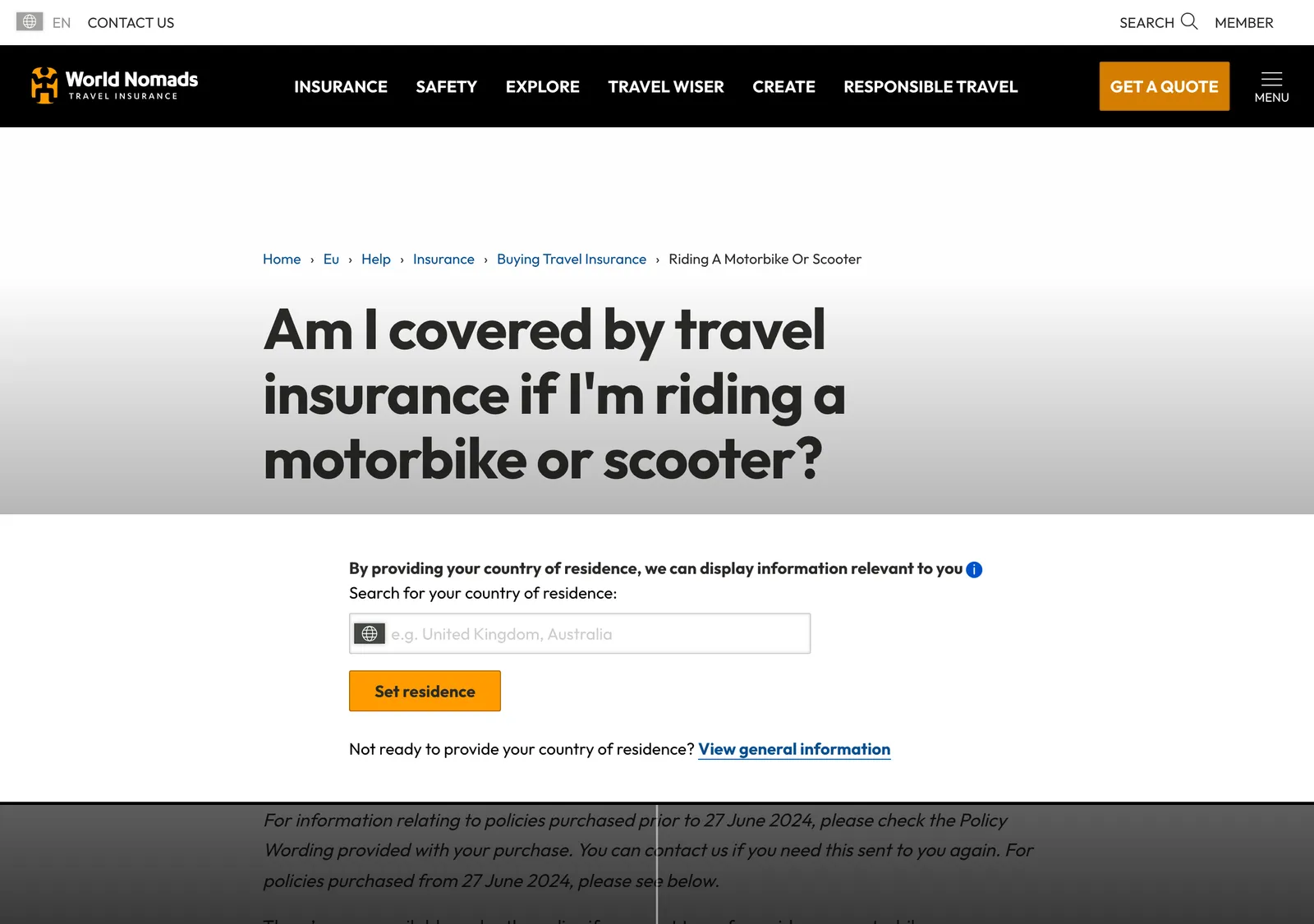
The conditions of cover include a valid motorbike licence in the country of residence and in the local country, for the size of bike. They include wearing a helmet and obeying the local road rules.
An injured rider has emergency medical expenses overseas listed as cover. Theft of or damage to the motorbike, owned, borrowed or rented, is not covered. Personal liability while riding or using the vehicle is not covered.
Allianz Travel (Australia)
Riding motorcycles, scooters and mopeds is not covered under the Allianz Australia Comprehensive, Basic or Multi-Trip plans. It offers an optional Adventure Pack for riders.
The pack asks for the appropriate class of licence, or one valid in the country if the Australian licence is not recognised there. A pillion passenger (the passenger behind the rider) is covered when the driver holds a licence valid for the vehicle and the country.
It also asks for an appropriate safety helmet at all times. Racing and professional riding are outside it. Even with the pack, Permanent Disability and Personal Liability benefits do not apply to claims from these activities.
Riding without a valid licence
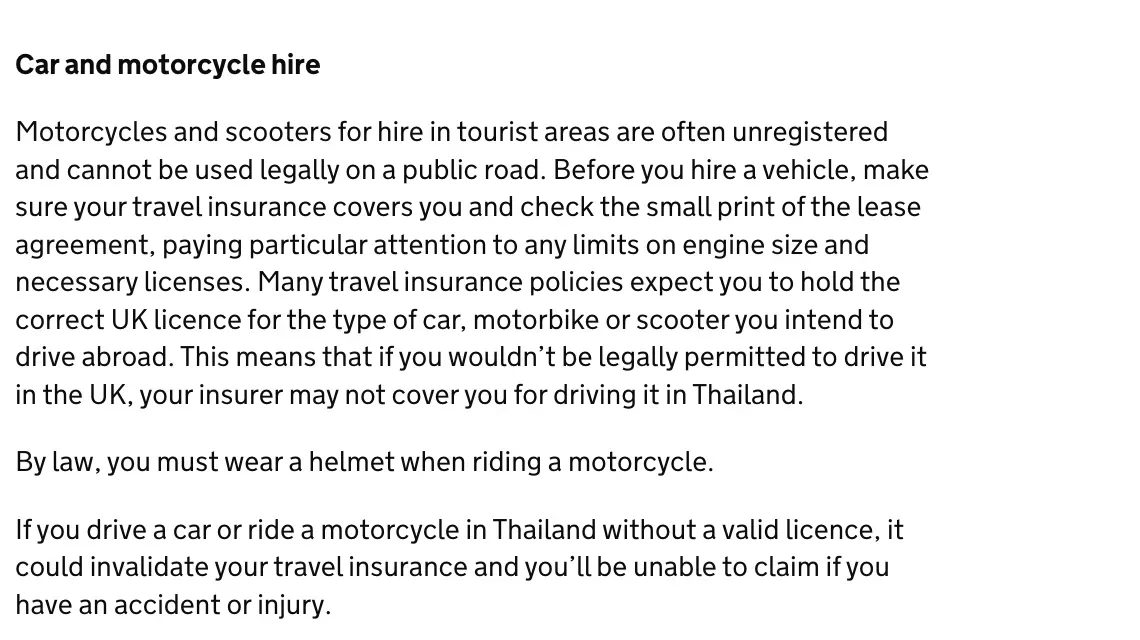
The UK government says riding a motorcycle in Thailand without a valid licence could invalidate travel insurance, and a claim after an accident or injury would fail.
A car licence does not stand in for a motorbike licence. Australian advice says a valid motorcycle licence is needed, and some rental companies will say otherwise. Driving without a licence also carries up to 1 month in jail or a fine up to THB 1,000.
Licence steps are in Thailand Driving Licence in Chiang Mai: Documents and Fees and International Driving Permit in Thailand: What the Sources Say.
Voluntary classes for owners
Voluntary cover is optional insurance that complements the compulsory insurance Thai law requires. Roojai sells the labels type 1, 2, 2+, 3 and 3+. These are Roojai’s own descriptions.
- Type 1: damage to your own motorcycle in an accident with or without a third party.
- Types 2+ and 3+: damage to your own bike in an accident with a third party.
- Types 2 and 3: third-party liability, plus medical expenses.
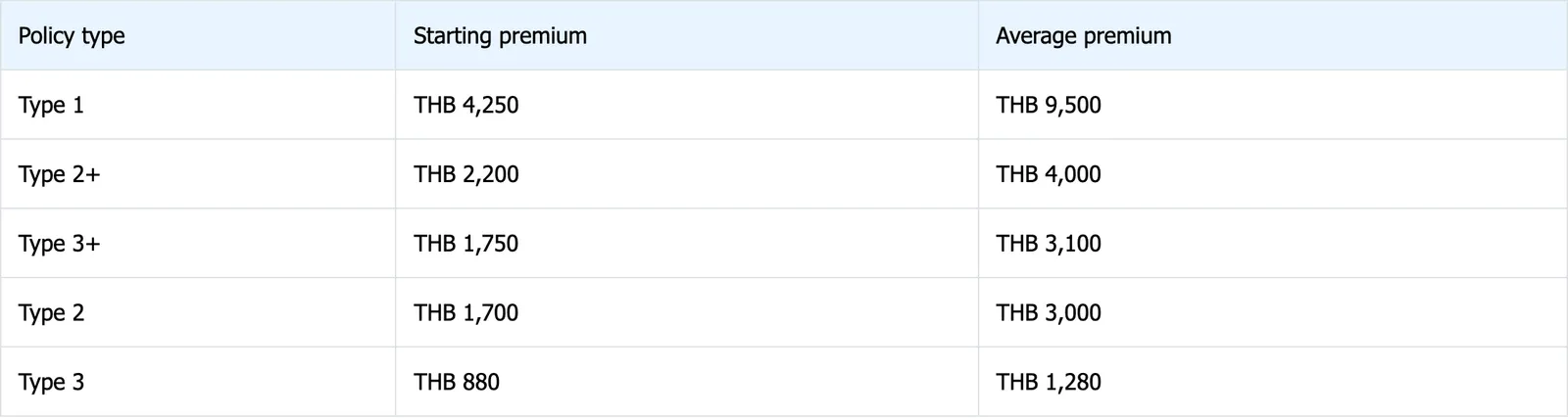
Roojai’s table puts starting premiums from THB 880 for type 3 to an average of THB 9,500 for type 1.
Roojai asks for a buyer aged 25 to 65 with a valid driving licence and for a motorcycle registered in Thailand. That makes this an owner’s product. A short-term tourist on a rental uses the compulsory layer, the renter policy above and travel insurance.
Claim steps by layer
Compulsory claim
Ask for preliminary damages within 180 days of the date the harm happened. The insurer or the fund must pay within seven days of the request, without waiting for fault to be proved. An insurer cannot refuse by pointing to a breach of policy conditions between insurer and owner or to the insured person’s fraud or gross negligence.
The claim asks for the hospital receipt or proof of the medical bill and a copy of an identity card, alien identity document, passport or other official document. Roojai adds a police report with the case outcome on compulsory bodily-injury claims. It says it pays an approved compulsory claim within 7 days.
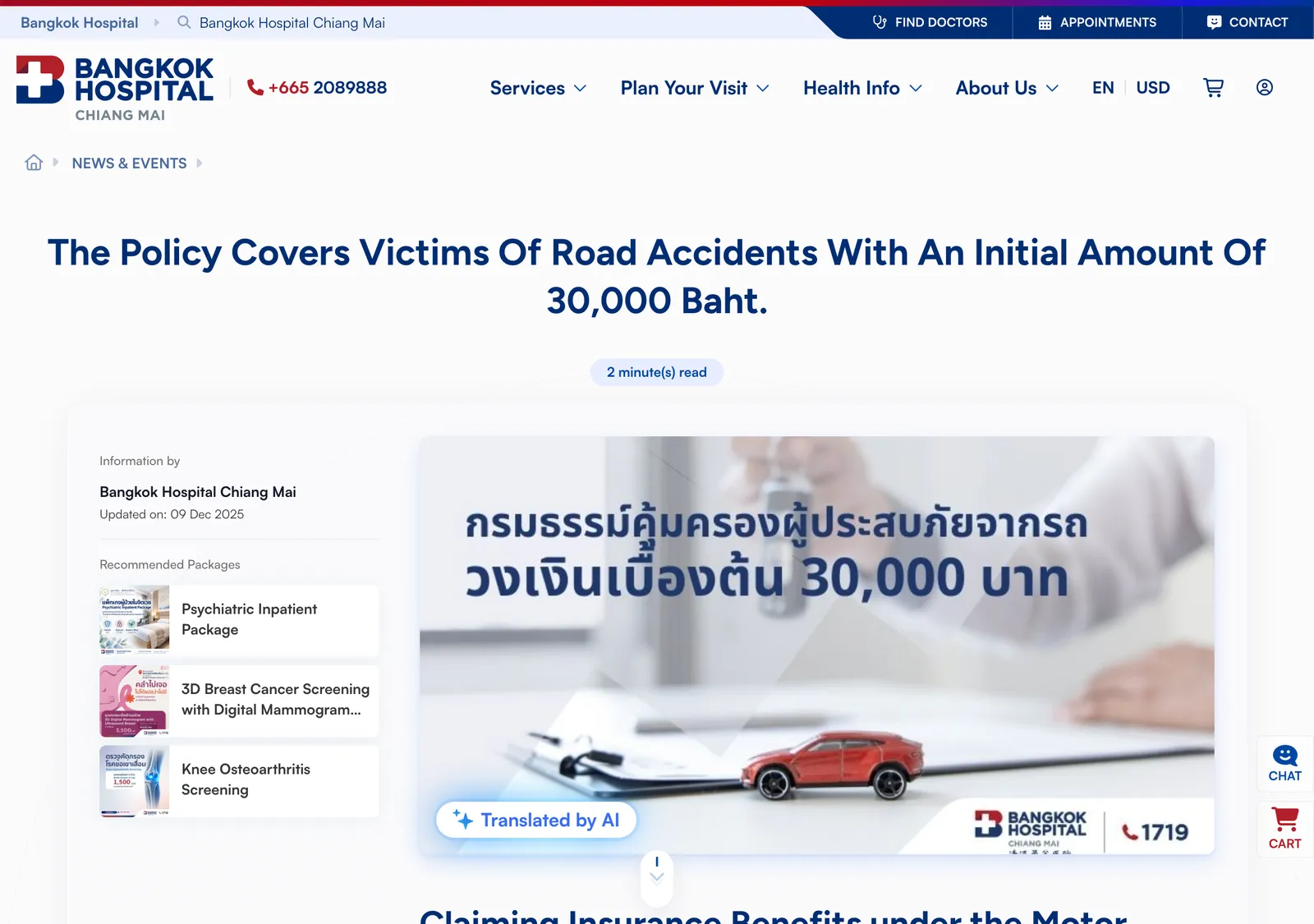
Bangkok Hospital Chiang Mai accepts patients using the Act’s benefits up to THB 30,000. The entitlement can be used without upfront payment when all documents are in place.
Receiving preliminary damages does not remove the right to claim more under the Civil and Commercial Code.
Voluntary claim (Roojai as the example)
- Call the insurer straight away. If anyone is injured, call an ambulance first, then the insurer.
- File by live video in the insurer’s app, or wait for a surveyor sent to the scene.
- Have the driver’s licence, the vehicle registration copy and the policy copy ready. For vehicle damage Roojai asks for a copy of the driver’s licence at the time of the accident.
- Roojai pays an approved voluntary claim within 15 days, the timeframe in the Registrar’s regulations.
Police are on 191 and an ambulance on 1669.
Travel insurance claim
The insured or someone with them must contact the World Nomads 24/7 Emergency Medical Assistance Team immediately. Keep the police report, the hospital papers and the policy number with you.
Before you ride: a checklist
- A valid motorbike licence for the bike’s size, in your country of residence and in Thailand.
- A helmet, worn by rider and passenger.
- Travel insurance with the scooter activity added when the policy is bought.
- The shop’s conditions read before you sign, since the renter pays damage and a bike not returned, and many hire companies have no insurance.
- Evidence of the compulsory insurance kept ready to show an officer.
Photo credits
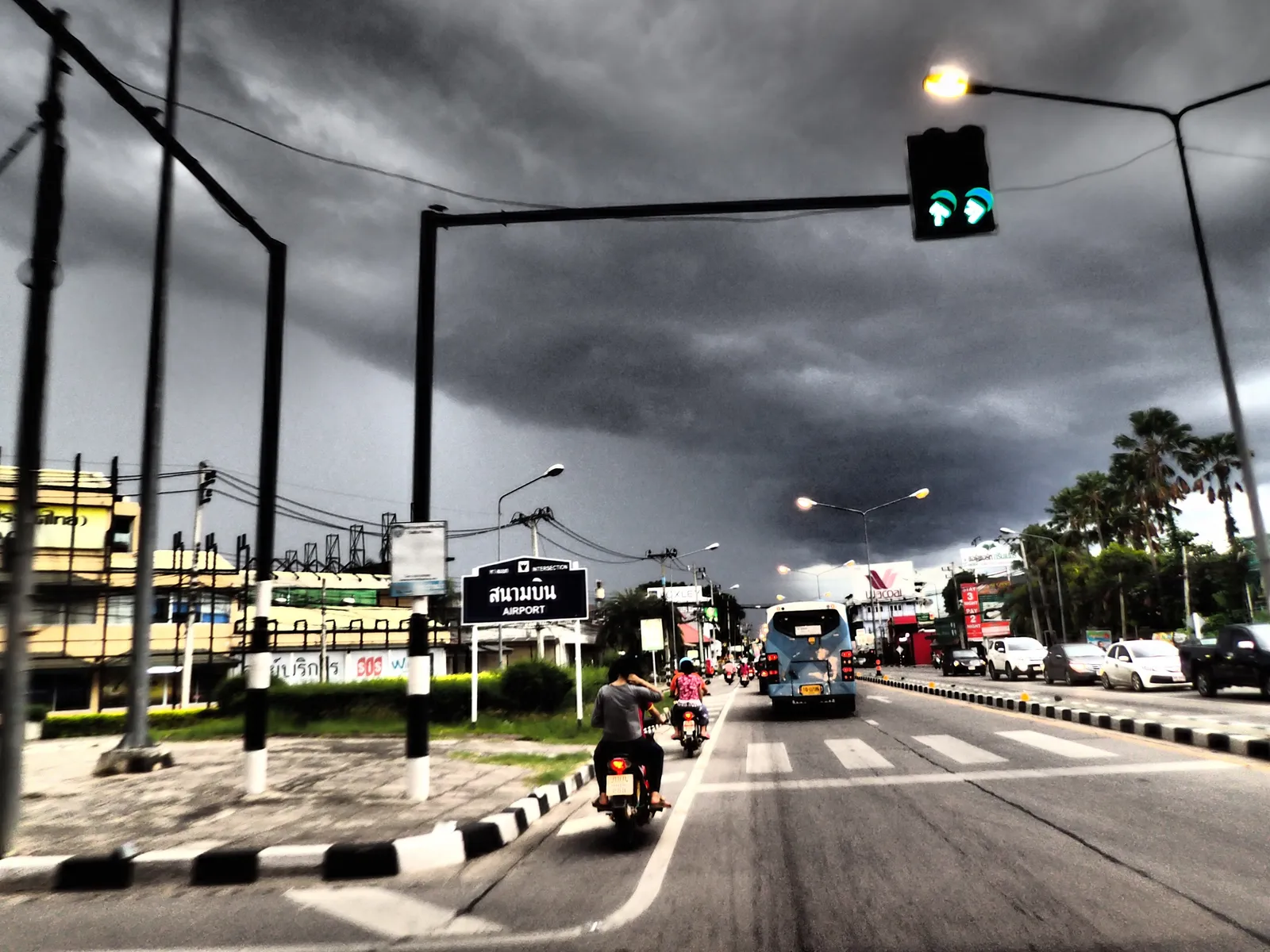
- A main road in Chiang Mai under rain clouds: Thipanet Road, Chiang Mai, Wikimedia Commons (opens in a new tab), Gozitano (CC BY-SA 4.0)
Not confirmed: No Thai regulator page defining the voluntary classes was found, so they rest on one insurer's wording. A shop's exact cover sits in the contract you sign, and the short-term renter policy is one seller's page. Whether a travel policy pays a rider without a valid licence sits in that policy's wording.
Reach readers planning life in Chiang Mai. Advertise → hello@chiangmaijao.com
Common questions
Does Por Ror Bor cover damage to a rented scooter?
No. The compulsory policy gives no cover for damage to your own or third-party property. It pays injury and death amounts per person.
Who pays if I damage or lose a rented scooter?
The renter. A shop's own conditions make the renter the temporary owner, responsible for anything that happens with the bike. A bike not returned costs the price of a new one.
Is there insurance I can buy for a rented scooter?
A short-term policy for renters pays up to THB 500,000 per person for injury to a third party and THB 200,000 for third-party property. You pick the dates, and you can buy after the rental has started.
Can a tourist buy voluntary class 1 or 2+ insurance?
Not as a rule. Roojai asks for a motorcycle registered in Thailand and a buyer aged 25 to 65 with a valid driving licence. That describes the owner of a bike, not a short-term renter.
Does travel insurance cover scooter riding in Thailand?
It depends on the insurer. World Nomads covers a scooter under 125cc when the activity is added at purchase, with a valid motorbike licence and a helmet as conditions. Allianz Australia's standard plans do not cover riding; its optional Adventure Pack does, and it also asks for a licence valid for the vehicle.
What if I ride without a valid licence?
Riding without a valid licence could invalidate travel insurance and stop a claim after an accident or injury. Driving without a licence also carries up to 1 month in jail or a fine up to THB 1,000.
How long does the compulsory insurer have to pay?
The insurer or the fund must pay preliminary damages within seven days of the request, without waiting for fault to be proved. The victim must ask within 180 days.
How fast does a voluntary insurer pay?
Roojai pays an approved voluntary claim within 15 days, the timeframe in the Registrar's regulations.
Does the insurer need a police report?
Roojai asks for a police report with the case outcome on a compulsory bodily-injury claim. Bangkok Hospital Chiang Mai asks for the original police daily log.
Read next
General information checked against the sources listed above, not legal advice for your situation. Rules and office practice change; confirm with the immigration office or a licensed adviser before you act. See how guides are checked.
Spotted an error? Report it.