Bring a Dog or Cat to Chiang Mai: Permit, Vaccines, Arrival
Email the Chiang Mai airport quarantine station at least 7 days and no more than 60 days before departure. Vaccinate first and wait 21 days before applying. On arrival the station issues the import approval and licence for THB 500 per animal, and customs duty still applies.
On this page
At the Chiang Mai airport quarantine station, officials check the traveller’s original passport, the pet’s vaccination records, the endorsed health certificate and the printed import permit. Then the station issues the import approval notice (Form R-6) and import licence (Form R-7). The permit request opens no earlier than 60 days before departure.
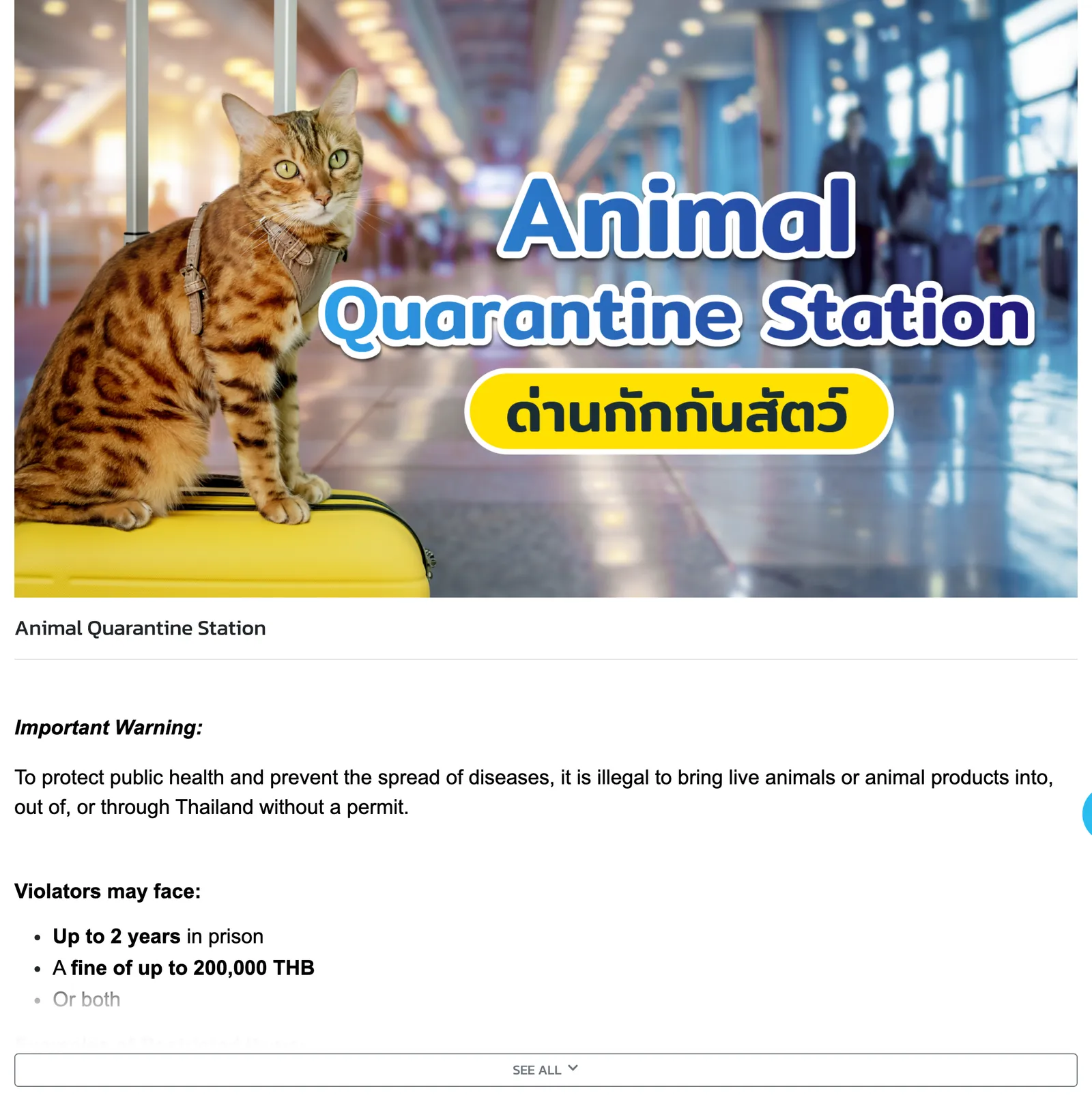
The sequence at a glance
- Check the vaccines: dogs need rabies, canine distemper, canine hepatitis, canine parvovirus and leptospirosis; cats need rabies and feline panleukopenia.
- After the primary vaccines, wait 21 days before applying.
- Email the Chiang Mai station at qscm_cmi@dld.go.th at least 7 days and no more than 60 days before departure.
- Get an English health certificate signed or endorsed by a government veterinary official of the exporting country.
- Arrive with the originals and the printed permit.
- Pay THB 500 per animal for the R-6 and R-7, then declare the pet to customs.
Step 1: microchip and vaccines
The permit application includes the pet’s microchip implantation certificate. Form R1/1 carries the pet’s breed, sex, date of birth, colour and microchip number.
For a primary rabies vaccine, the pet must be at least 12 weeks old at vaccination. After all primary vaccines, the owner waits 21 days before starting the permit application. Booster shots carry no waiting period, but the earlier vaccination records must be submitted.
A dog without a valid leptospirosis vaccine, or without the 21-day gap, needs a negative leptospirosis test within 30 days before departure.
A country free of rabies for at least 12 months needs no rabies vaccination; otherwise the pet needs an approved vaccine at least 21 days before departure. The vaccination certificates are in English and carry the veterinarian’s full name, licence number and signature.
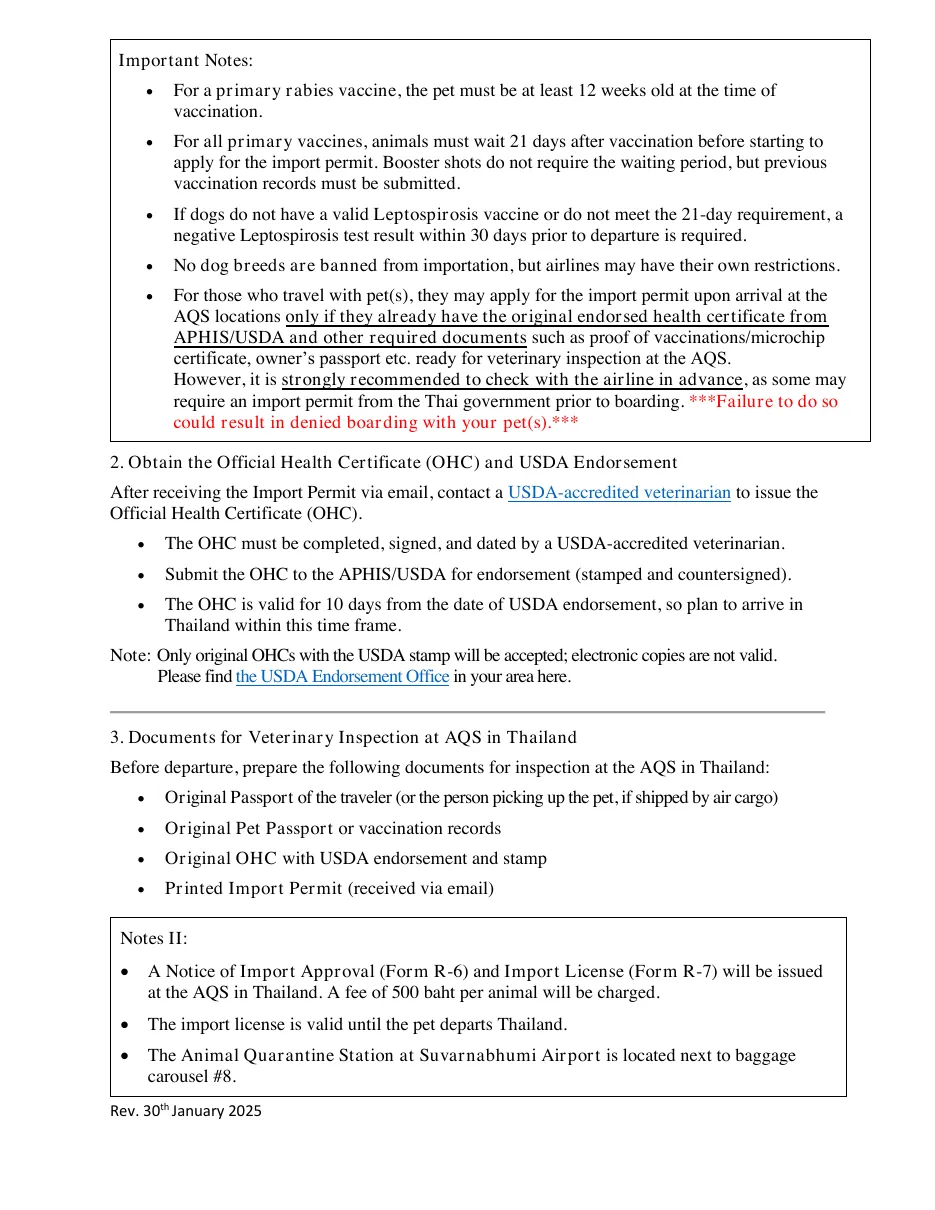
Step 2: the import permit by email
Dogs and cats need an import permit from the Animal Quarantine Station (AQS), requested by email at least 7 days and no more than 60 days before departure. A February 2025 consulate page words the minimum as 7 business days. The Chiang Mai International Airport station takes applications at qscm_cmi@dld.go.th. The Vancouver consulate asks for the request not less than 7 working days ahead.
Attach these items:
- Application form R1/1, with the traveller’s name, the address in Thailand and the country of origin.
- The pet’s microchip implantation certificate.
- A copy of the flight confirmation.
- A copy of the traveller’s passport.
- A colour photo of the pet with the face clearly shown.
- English vaccination certificates.
Allow 5-7 Thai business days after the station receives all documents; the permit is valid for 60 days after issue, and the sheet recommends applying 30 days before departure.
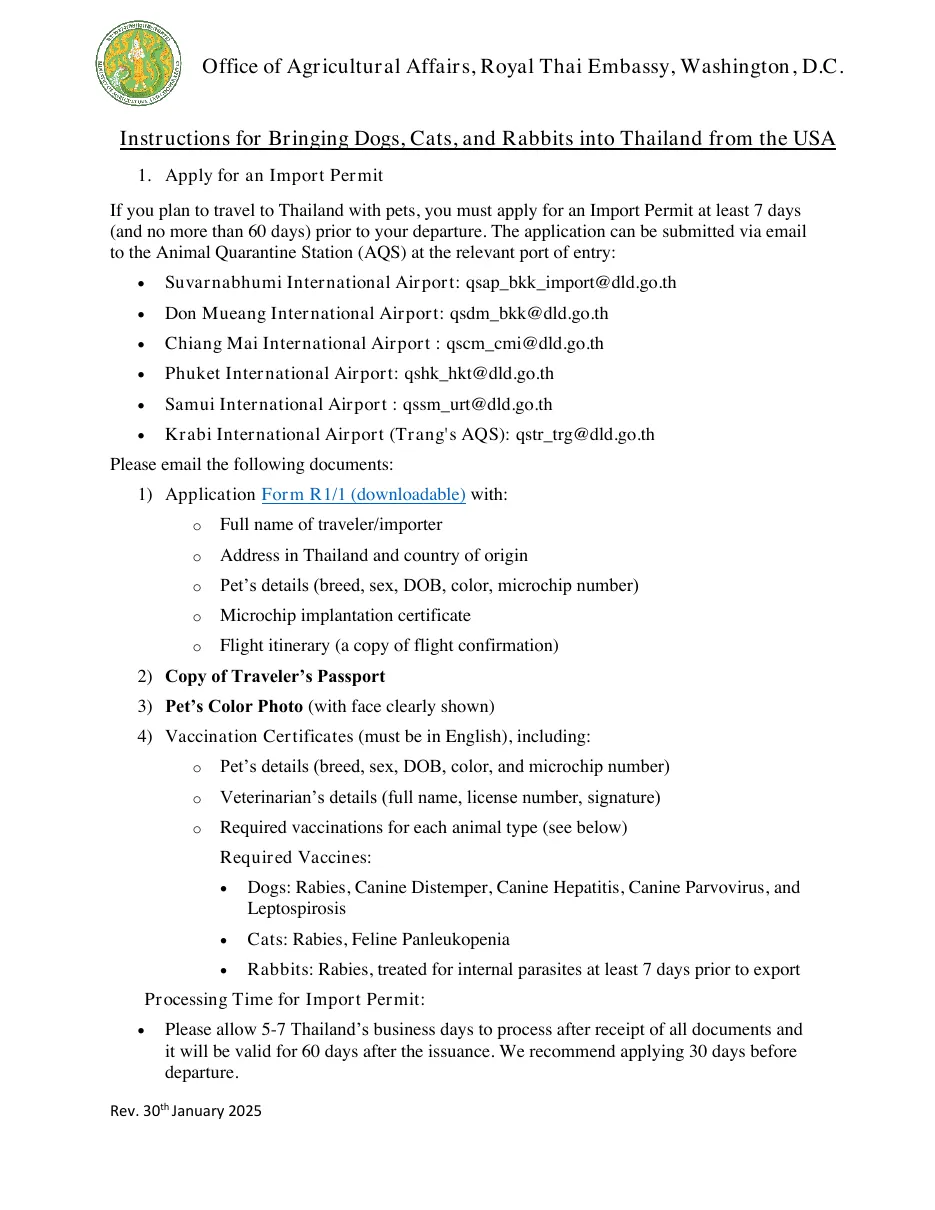
Check with the airline first, because some require the Thai import permit before boarding and a pet without it may be refused. Apply by email before you fly rather than on arrival. A traveller may apply on arrival only if the endorsed certificate and other documents are ready for inspection.
On breeds, the newest dated source, the Chicago consulate page of 11 Feb 2025, says no dog breed is banned. A January 2025 sheet agrees, though airlines may have their own restrictions. A July 2022 Sydney consulate page still lists the Pit Bull Terrier and American Staffordshire Terrier as prohibited. If you own either breed, ask your airline and the station before you book.
Step 3: health certificate, crate and flight
A health certificate in English must be signed or endorsed by a full-time authorised veterinary official of the exporting country’s government. On the US route the certificate is valid for 10 days from the endorsement, so the flight has to land inside that window. Only original certificates with the official stamp are accepted, and electronic copies are not valid.
The animals travel in nose-and-paw-proof crates designed to avoid injury.
Plan on the newest dated source, the Chicago consulate page of 11 Feb 2025: the Chiang Mai station is open 08:30 to 16:30, Monday to Sunday. Older information gives 24 hours daily, so a late landing may still work, but do not count on it until the station confirms by email.
The Saturday and Sunday closure applies to a pet shipped as air cargo, not to a hand-carried pet. For cargo, pickup is only during business hours, Monday to Friday. The station is closed on Saturday, Sunday and Thai holidays.
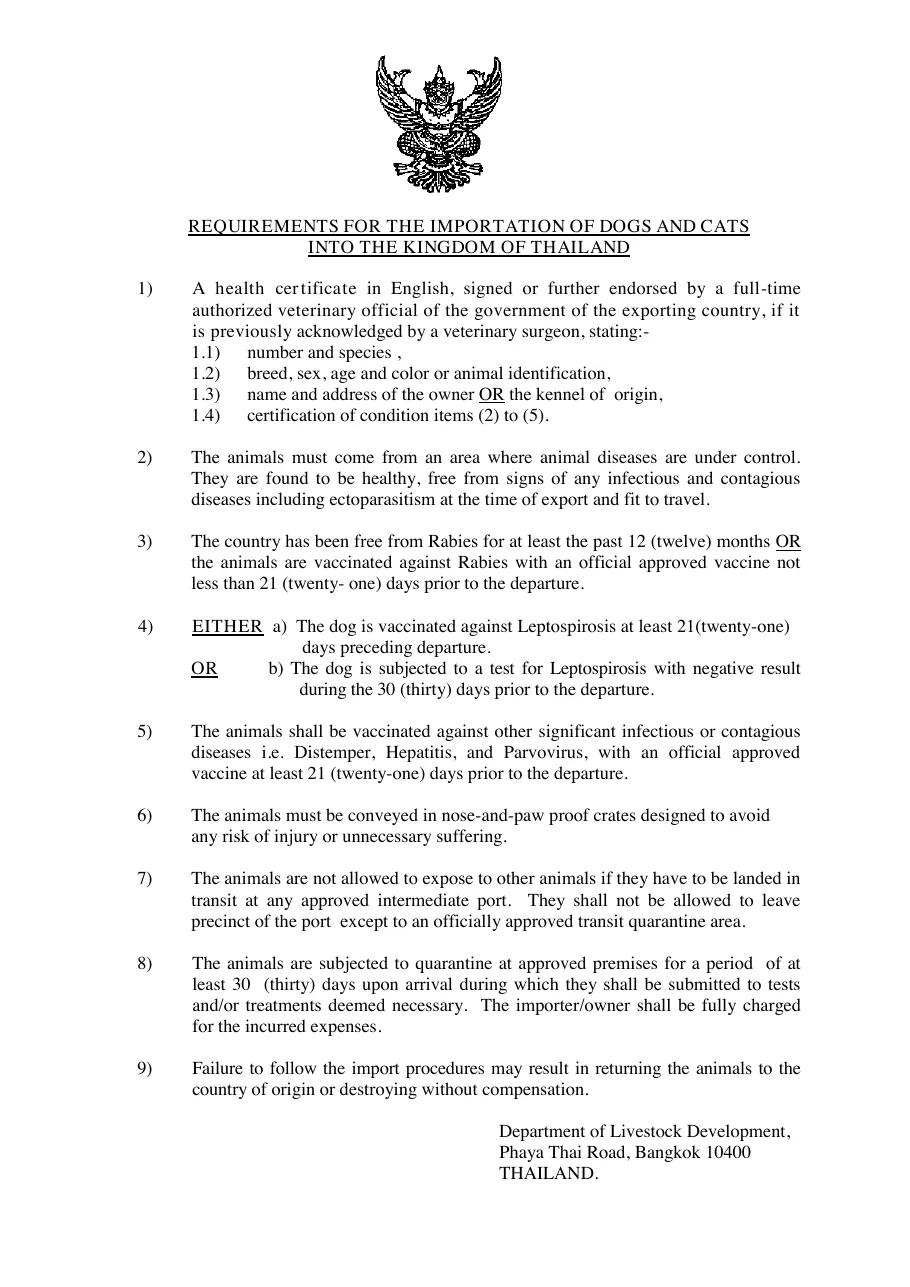
Step 4: arrival at Chiang Mai airport
After immigration the passenger collects baggage and the pet. The passenger then takes the pet and documents to the quarantine station, where officials issue the import permit if the pet meets the requirements. Bring the original passport, the original pet passport or vaccination records, the original endorsed certificate and the printed permit.
The station issues the Notice of Import Approval (Form R-6) and Import Licence (Form R-7), and charges THB 500 per animal.
AOT, the airport operator, lists the station at the “1st Chiang Mai International Terminal”.
The address is No. 60, Mahidol Road, Suthep Subdistrict, Mueang Chiang Mai District, 50200. The station telephone is (+66)5 344 7653. The January 2025 sheet lists a different number for the same station, +(665) 389 2453. Email is the documented route for the permit.
60 ถนน มหิดล Suthep, Mueang Chiang Mai District, Chiang Mai 50200, Thailand · Open in Google Maps (opens in a new tab)
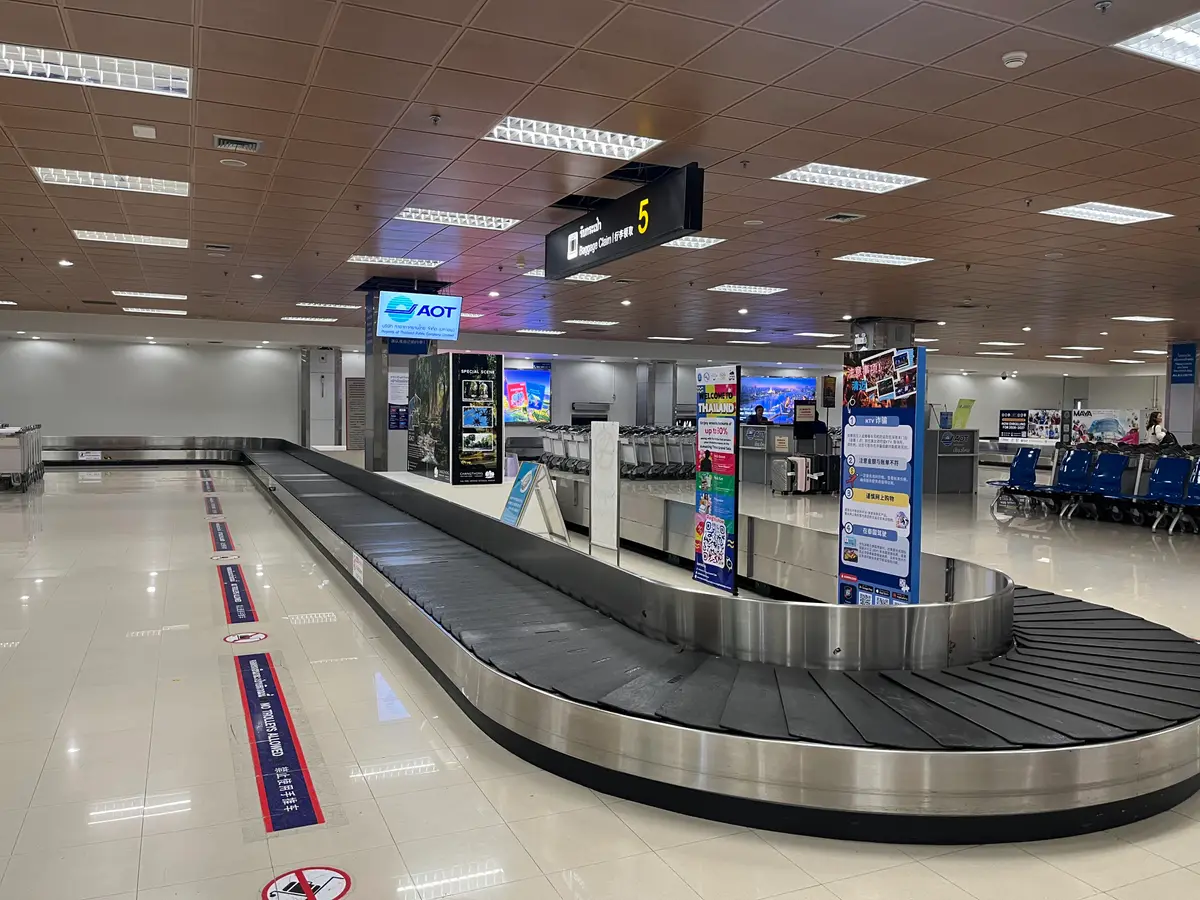
The pet and the permit then go to the customs officers at the “Goods to Declare” channel, where duty and taxes are paid. Pets are not exempt from duty.
What the inspection can decide
A pet that shows no sign of illness is not quarantined. A quarantine officer can still detain any pet at their discretion.
If the pet fails the requirements, or the microchip number differs from the documents, it may be returned to the exporting country. It may instead be detained at a government-approved quarantine at the importer’s cost. Failing the import procedures may lead to return or destruction without compensation.
What it costs and what the law says
| Item | Amount |
|---|---|
| Import approval and licence (R-6, R-7) | THB 500 per animal |
| Customs duty and taxes | Not exempt; paid at Goods to Declare |
| Entering without a permit | Up to 2 years in prison and a fine of up to THB 200,000 |
Bringing live animals into, out of or through Thailand without a permit is illegal. The Animal Epidemics Act B.E. 2558 is part of the legal basis for animal imports and exports.
The import licence (Form R-7) is valid until the pet departs Thailand. You must reapply once you leave the country. A 2018 department page gave 7 days; the newer pages replace it.
Leaving Thailand with your pet
Contact both the destination country’s authority and the Thai animal quarantine station to check the requirements. The pet and documents go to the quarantine station at the exit port for a document and health check. The export permit application and health check happen no more than 3 days before departure.
The station issues an export licence (Form R.9) and commonly an official health certificate. The R.9 is valid for 9 days and the certificate for 10 days. A pet leaving Thailand should be at least 4 months old, depending on the importing country.
Pets are microchipped before or on the same day as the rabies vaccination. A rabies titre test certificate is required by the EU, the US (Hawaii), Japan and others.
Related guides
- Chiang Mai Airport to the City: Taxi, Grab, Bus
- First Week in Chiang Mai: A Day-by-Day Checklist
- Rent an Apartment in Chiang Mai: Deposit, Contract, TM30
Photo credits
- Photos and clips uploaded to Google Maps (Chiang Mai International Airport on Google Maps (opens in a new tab)) by Gaga Bichon, Google Maps contributor, Jordan Kuo.
Step by step
- Vaccinate and wait 21 daysGive the primary vaccines at 12 weeks or older for rabies, then wait 21 days before applying for the permit.
- Email the Chiang Mai stationSend form R1/1 and the attachments to qscm_cmi@dld.go.th at least 7 days and no more than 60 days before departure.
- Get the health certificateA government veterinary official of the exporting country signs or endorses an English certificate.
- Bring originals to the stationShow the passport, vaccination records, endorsed certificate and printed permit.
- Pay and declarePay THB 500 per animal for the R-6 and R-7, then go to the Goods to Declare channel.
Not confirmed: Station hours for a hand-carried pet: two 2025 embassy sheets disagree and no newer department text exists. Plan on 08:30 to 16:30 daily and email the station before booking a flight that lands outside those hours. Ask customs at the Goods to Declare channel what duty applies to your pet.
Reach readers planning life in Chiang Mai. Advertise → hello@chiangmaijao.com
Common questions
Does my dog or cat need an import permit for Chiang Mai?
Yes. A permit from the Department of Livestock Development is required when passengers bring pets with them. Entering without one carries up to 2 years in prison or a fine of up to THB 200,000.
How early must I apply for the permit?
At least 7 days and no more than 60 days before departure. The embassy sheet recommends applying 30 days before departure.
How long does the permit take?
Allow 5-7 Thai business days after the station receives all documents, and the permit is valid for 60 days after issue.
Which vaccines are needed?
Dogs need rabies, canine distemper, canine hepatitis, canine parvovirus and leptospirosis. Cats need rabies and feline panleukopenia.
How old must the pet be for rabies vaccination?
At least 12 weeks old at the primary rabies shot. Then wait 21 days after primary vaccines before applying for the permit.
What does the airport station charge?
THB 500 per animal for the import approval (Form R-6) and import licence (Form R-7). Pets are not exempt from customs duty.
Can I apply for the permit on arrival?
Travellers with the pet may apply on arrival only if the endorsed health certificate and other documents are ready for inspection. An airline may refuse boarding without the permit.
Are any dog breeds banned?
No breed is banned on the newest dated source, the Chicago consulate page of 11 Feb 2025, and a January 2025 sheet agrees, though airlines may set their own limits. A July 2022 Sydney consulate page still lists the Pit Bull Terrier and American Staffordshire Terrier as prohibited. If you own either breed, ask your airline and the station before you book.
Will my pet be quarantined?
Not if it shows no sign of illness and the papers are complete. A quarantine officer can still detain any pet at their discretion.
Who do I call at the Chiang Mai station?
Call (+66)5 344 7653. The January 2025 embassy sheet lists +(665) 389 2453. Email qscm_cmi@dld.go.th for the permit.
Read next
Places in this guide

General information checked against the sources listed above, not legal advice for your situation. Rules and office practice change; confirm with the immigration office or a licensed adviser before you act. See how guides are checked.
Spotted an error? Report it.