Thailand DTV Visa in Chiang Mai: Funds, Fees, Extension
A first-time applicant needs a qualifying purpose such as remote work and financial evidence of at least THB 500,000. Apply online on the Thai e-Visa platform. The visa lasts 5 years, with 180 days per entry and one 180-day extension. Your embassy sets the fee, for example 350 euros in Berlin, not the THB 10,000 on the ministry infographic.
On this page
A first Destination Thailand Visa (DTV) needs a qualifying purpose such as remote work and financial evidence of at least THB 500,000. You apply online on the Thai e-Visa platform.
The visa is valid for 5 years, with up to 180 days per entry and one 180-day extension. Your embassy sets the fee, so you pay the amount on its page, not the THB 10,000 on the ministry infographic.
Who qualifies and what you need
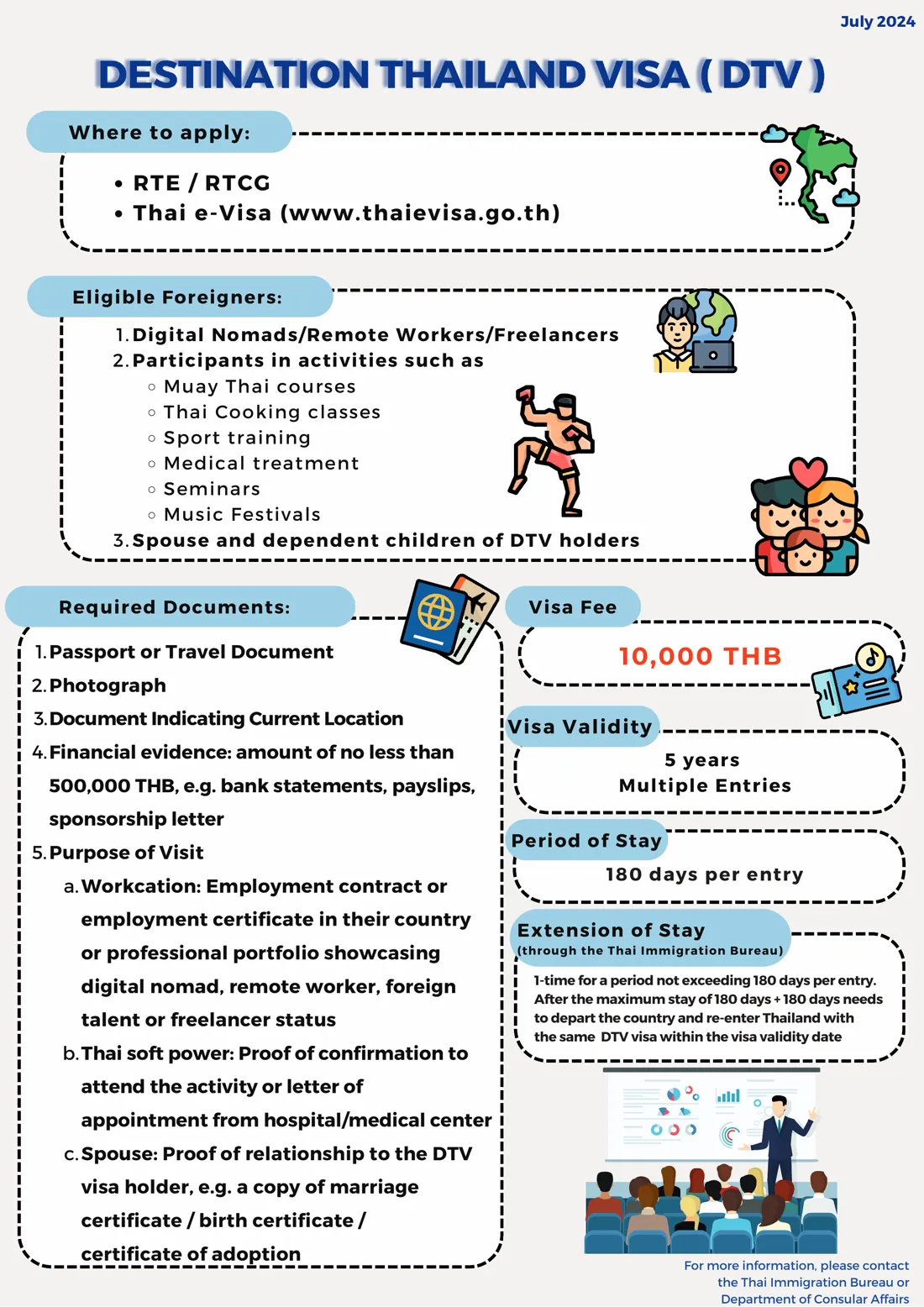
The DTV is for three groups of people.
- Remote workers: foreign talent, freelancers and digital nomads who travel and work remotely in Thailand.
- Activity participants: people joining Muay Thai courses, cooking classes, sport training, medical treatment, seminars or music festivals.
- Family: a spouse and children under 20 of a DTV holder.
For a first application, the checklist is short.
- Funds: financial evidence of at least THB 500,000, for example bank statements or a sponsorship letter.
- Residence: proof of permanent residence in the country where you apply.
- Work: for remote work, an employment contract or certificate, or a business registration for freelancers.
- Police record: a criminal record clearance certificate, not older than 3 months at the Munich consulate.
- Where: online on the Thai e-Visa platform at thaievisa.go.th, through the post for your country of residence.
- Validity: 5 years, with up to 180 days per entry.
- Fee: set per embassy, see the table below.
The DTV is a multiple-entry visa with no limit on the number of entries while it is valid.
Funds and documents
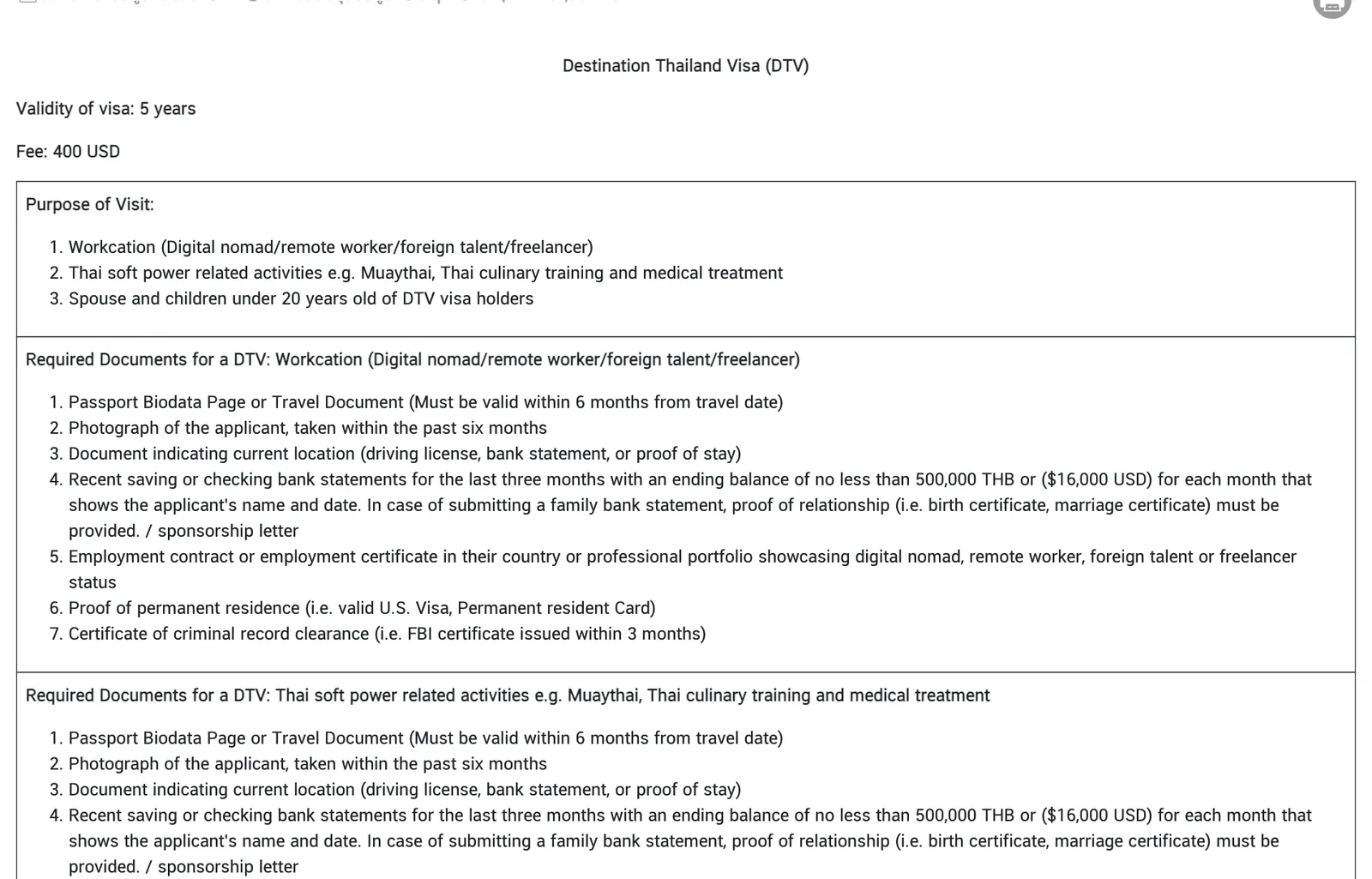
The embassy pages below ask for financial evidence of at least THB 500,000. The form it takes differs by embassy.
Funds proof
- Ho Chi Minh City: bank statements or a sponsorship letter.
- Munich: bank statements, proof of earnings or a sponsorship letter.
- Taipei: the last 3 months of bank statements with a minimum balance of THB 500,000, or sponsorship letters.
- Washington D.C.: statements for the last three months, with an ending balance of no less than THB 500,000 for each month.
- Kuala Lumpur: a copy of the bank statement for the last 3 months with an ending balance of no less than THB 500,000.
- Ministry infographic: examples of financial evidence include bank statements and payslips.
Purpose and other documents
For the remote-work purpose, the Washington D.C. embassy asks for an employment contract or employment certificate in the applicant’s country, or a professional portfolio. It also asks for a criminal record certificate, for example an FBI certificate issued within 3 months.
The Munich consulate asks for an employment contract or employment certificate, or a business registration for freelancers. Its criminal record clearance certificate may come from the country of nationality or the country of application. The Ho Chi Minh City consulate also asks for one.
Documents must be in Thai or English.
Missing, screenshot or unclear files lead to a request for more documents and a delay.
Remote workers show work for an employer or clients abroad. The Ho Chi Minh City consulate asks for an employment contract from an employer outside Thailand.
From 31 August 2026 the document list changed. Proof of permanent residence replaced the document showing the applicant’s current location. A criminal record clearance certificate was added.
Washington D.C. lists a valid U.S. visa or a permanent resident card as examples of residence proof. Munich asks for proof of permanent residence in the country where you apply, and you must be in Germany when submitting and paying.
How to apply and what it costs
Steps
- Choose your embassy or consulate on the Thai e-Visa platform at thaievisa.go.th and apply online.
- Upload your documents. Washington D.C. warns that missing or unclear files delay processing.
- Pay the fee. Pay by credit card through the e-Visa system. The fee is non-refundable.
- Wait for the decision. The standard time is 5 working days in Ho Chi Minh City, not counting the submission day, and within 15 consular days in Munich.
- Apply with margin. Submit at least 2 weeks before travel at Ho Chi Minh City, where an expedited application is not available.
Nationals of certain countries must apply at the Thai embassy or consulate in their home or residence country, or at a designated embassy.
DTV fee by embassy
THB 10,000 is the ministry’s baseline. Each post charges its own amount in local currency, and that is what you pay. The table shows each post’s fee and the date of the page or announcement it comes from.
| Embassy | Fee | Same fee in baht, at the post’s own funds ratio | Source date |
|---|---|---|---|
| Berlin | 350 euros | Not published | Fee table dated 18 Nov 2024 |
| Munich | 350 euros | THB 14,000 | Page checked 15 Oct 2026, no date shown |
| Helsinki | 350 euros | Not published | Notice updated 26 Aug 2026 |
| London | GBP 300 | THB 12,500 | Page updated 8 Sep 2026 |
| Washington D.C. | USD 400 | THB 12,500 | Page dated 10 Sep 2026 |
| Ottawa | CAD 650 | Not published | Announcement effective 16 Jul 2024 |
| Sydney (New South Wales) | AUD 600 | Not published | Announcement effective 15 Jul 2024 |
| Ho Chi Minh City | USD 340 | Not published | Page checked 13 Oct 2026, no date shown |
| Taipei | NTD 11,000, cash only | Not published | Page updated 14 Oct 2026 |
| Fukuoka | 52,000 yen | Not published | Page checked 13 Oct 2026, no date shown |
| Ministry infographic | THB 10,000 | THB 10,000 | July 2024 |
The baht column uses each post’s own funds line, which gives THB 500,000 in local currency. That is 12,500 euros in Munich, GBP 12,000 in London and USD 16,000 in Washington D.C.. It is the post’s conversion, not today’s exchange rate.
The Canberra embassy page does not state a fee. Fees are paid before travel and are non-refundable.
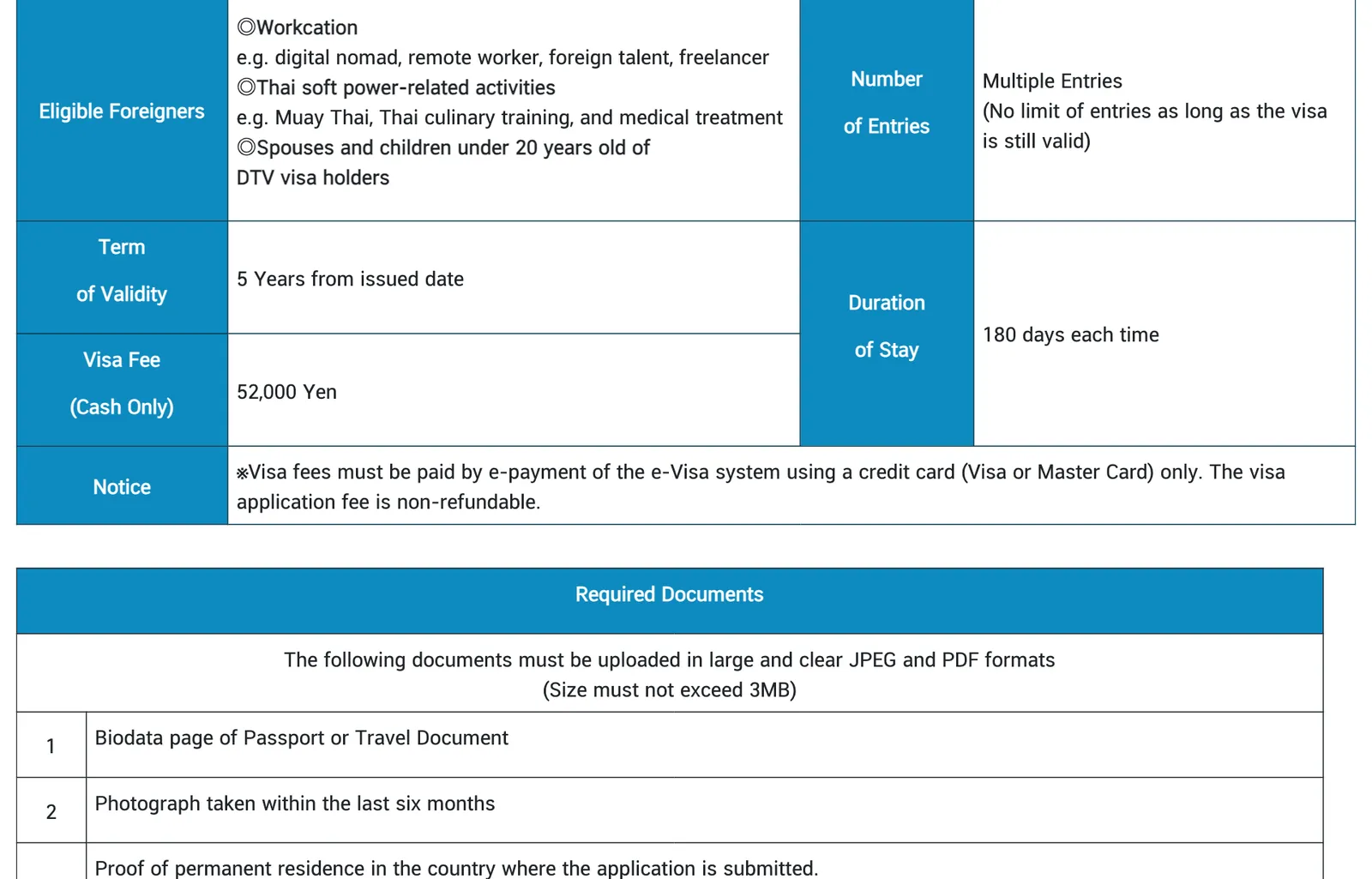
These are application fees paid abroad before travel. A holder already in Thailand pays the extension fee instead, covered below.
Second stay: extending the DTV in Chiang Mai
This part is for holders who are already in Chiang Mai. The visa lets the holder stay up to 180 days per entry. One extension of 180 days can follow, and then the holder must leave.
A one-time extension of up to 180 days per entry, made through the Thai Immigration Bureau. The Washington D.C. holders contact the Immigration Bureau directly once in Thailand.
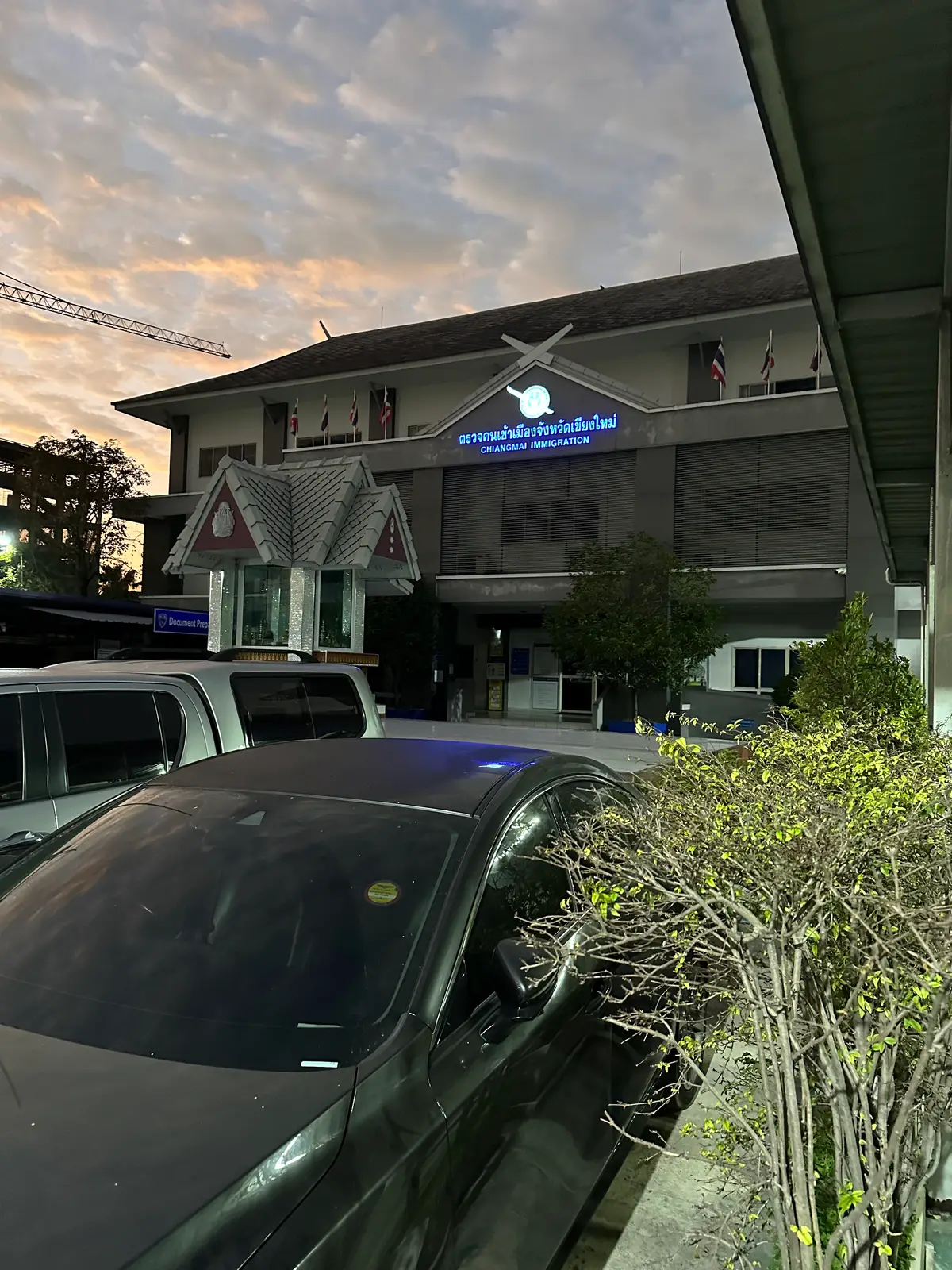
In Chiang Mai, the local office is Chiang Mai Immigration (ตรวจคนเข้าเมืองจังหวัดเชียงใหม่) at 71 Moo 3, Sanam Bin (Airport) Road, Suthep, Mueang, Chiang Mai 50200. The telephone is 053 201 755.
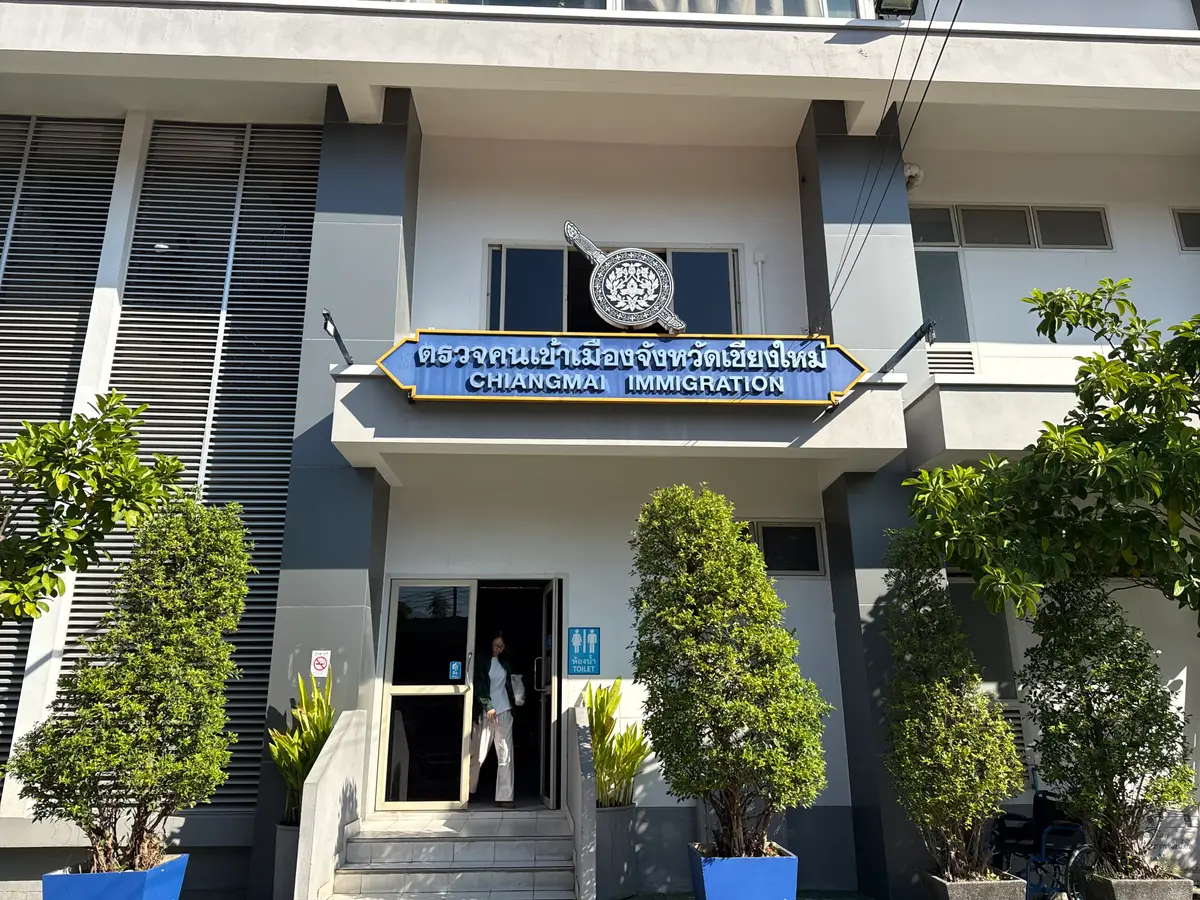
71 ถนนสนามบิน Suthep, Mueang Chiang Mai District, Chiang Mai 50200, Thailand · Open in Google Maps (opens in a new tab)
Open in Google Maps (opens in a new tab)
Which counter
Chiang Mai Immigration has two service points. The Services for Foreigner Section at Airport Road handles applications for and changes to all types of visa. The Central Festival Chiangmai point, on the 2nd floor, handles address reporting, visa re-entry and extensions for short-term tourist visas, teachers and students. The DTV is not named there, so Airport Road is the safer counter, and the number to call is 053 201 755.
The Central Festival point opens from 09:00 to 17:00 and its telephone is 065-765-7029.
Fee and hours
The Immigration Bureau fee list shows THB 1,900 for an extension of stay. The DTV pages do not state a fee for the extension, so treat THB 1,900 as the general extension fee.
A national Immigration Bureau handbook for tourist extensions gives counter hours of 08.30 -16.30 with a lunch break, Monday to Friday except official holidays. That handbook was published in November 2019, so confirm hours by phone.
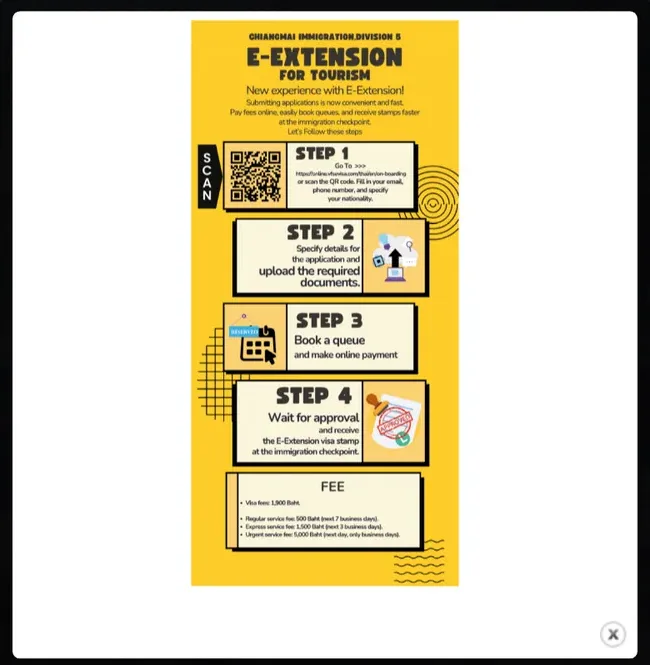
Chiang Mai Immigration also runs an online extension service for certain visa types only. It points applicants to thaiextension.vfsevisa.com. The pages found do not name the DTV among those visa types.
After 180 days plus the 180-day extension, the holder must leave Thailand and can re-enter on the same DTV within its validity. See the Chiang Mai retirement extension guide for how that office handles a different extension type.
Rules while you stay
A foreigner permitted to stay temporarily must notify an immigration officer of their address every ninety days. Section 37(5) of the Immigration Act B.E. 2522 sets this for stays longer than ninety days. The English text used here is the 1979 enactment, so later amendments are not reflected. See the address report guide for the Chiang Mai steps.
- Timing: a report can be made from 15 days before until 7 days after the due date.
- Online: Chiang Mai Immigration links an online 90-day report service, form TM.47.
- Late: a late report must be made in person with a THB 2,000 fine.
Leaving Thailand without a re-entry permit cancels the permitted stay. A single re-entry permit costs THB 1,000 and a multiple re-entry permit THB 3,800. It is applied for on form TM.8 with one 4x6 cm photo.
The overstay fine is THB 500 per day, capped at THB 20,000. Long stays also raise tax questions. See the tax residency guide.
Since 1 May 2025, non-Thai nationals entering by air, land or sea must complete the Thailand Digital Arrival Card online within 3 days before arrival. It must be submitted for every entry.
Photo credits
- Photos and clips uploaded to Google Maps (Chiang Mai Immigration Office on Google Maps (opens in a new tab)) by Peter Miller (WHY THAI), ben chidgey.
Step by step
- Check you fit a DTV purposeThe DTV covers remote work, activities such as Muay Thai or cooking courses, and family of a holder.
- Gather funds proof and purpose documentsFinancial evidence of at least THB 500,000 plus the documents your embassy lists.
- Apply onlineUse the Thai e-Visa platform at thaievisa.go.th.
- Enter within the visa's validityThe visa is valid for 5 years with up to 180 days per entry.
- Extend once if neededApply to the Immigration Bureau for one extension of 180 days.
Not confirmed: What Chiang Mai Immigration asks for at a DTV extension, such as funds proof and forms: it is not published, so call 053 201 755 before you go. Whether THB 1,900 applies to the DTV extension. Whether DTV holders can use online extension.
Reach readers planning life in Chiang Mai. Advertise → hello@chiangmaijao.com
Common questions
How long can I stay in Thailand on a DTV?
Up to 180 days per entry. One extension of 180 days can be granted through the Immigration Bureau. After 180 days plus 180 days, the holder must leave and can re-enter on the same DTV within its validity.
How much money do I need for a DTV?
Financial evidence of at least THB 500,000. Embassies ask for the last 3 months of bank statements, or a sponsorship letter.
How much does the DTV cost?
The embassy where you apply sets the fee in local currency. It is 350 euros in Berlin, GBP 300 in London, USD 400 in Washington D.C., CAD 650 in Ottawa and AUD 600 in Sydney. The headline fee is THB 10,000. The fee is non-refundable.
What documents does a German resident need for a DTV?
The Munich consulate asks for financial proof of at least THB 500,000 and proof of permanent residence. It also asks for an employment certificate or a freelancer's business registration. A criminal record clearance certificate must be no older than 3 months.
How long does a DTV application take?
The standard time is 5 working days in Ho Chi Minh City and within 15 consular days in Munich. Apply at least 2 weeks before travel.
Can I extend a DTV at Chiang Mai Immigration?
Once in Thailand, contact the Immigration Bureau. Chiang Mai Immigration's Services for Foreigner Section handles applications for and changes to all types of visa. The DTV extension criteria are not published on an official page, so ask at the counter.
How much does the DTV extension cost?
The Immigration Bureau fee list shows THB 1,900 for an extension of stay. That fee for the DTV is not officially confirmed.
Where do I apply for a DTV?
Online through the Thai e-Visa platform at thaievisa.go.th. Nationals of certain countries must apply at the Thai embassy or consulate in their home or residence country, or at a designated embassy.
Can my spouse and children come on a DTV?
A spouse and children under 20 of a DTV holder can also get a DTV.
Do I need a re-entry permit if I leave Thailand during my DTV stay?
Leaving Thailand without a re-entry permit cancels the permitted stay. A single re-entry permit costs THB 1,000 and a multiple one THB 3,800.
What happens if I overstay a DTV?
The overstay fine is THB 500 per day, capped at THB 20,000.
Read next
General information checked against the sources listed above, not legal advice for your situation. Rules and office practice change; confirm with the immigration office or a licensed adviser before you act. See how guides are checked.
Spotted an error? Report it.