Currency Exchange in Chiang Mai: Licensed Changers, Rates
Exchange foreign cash with a bank or an authorised money changer: Thai law requires foreign exchange to go through licensed persons. Bring your passport; Superrich Thailand asks for an ID card or an unexpired passport. Compare the buying rate with the Bank of Thailand's THB 33.521 interbank figure. One Chiang Mai changer showed THB 33.45 for USD 100 notes.
On this page
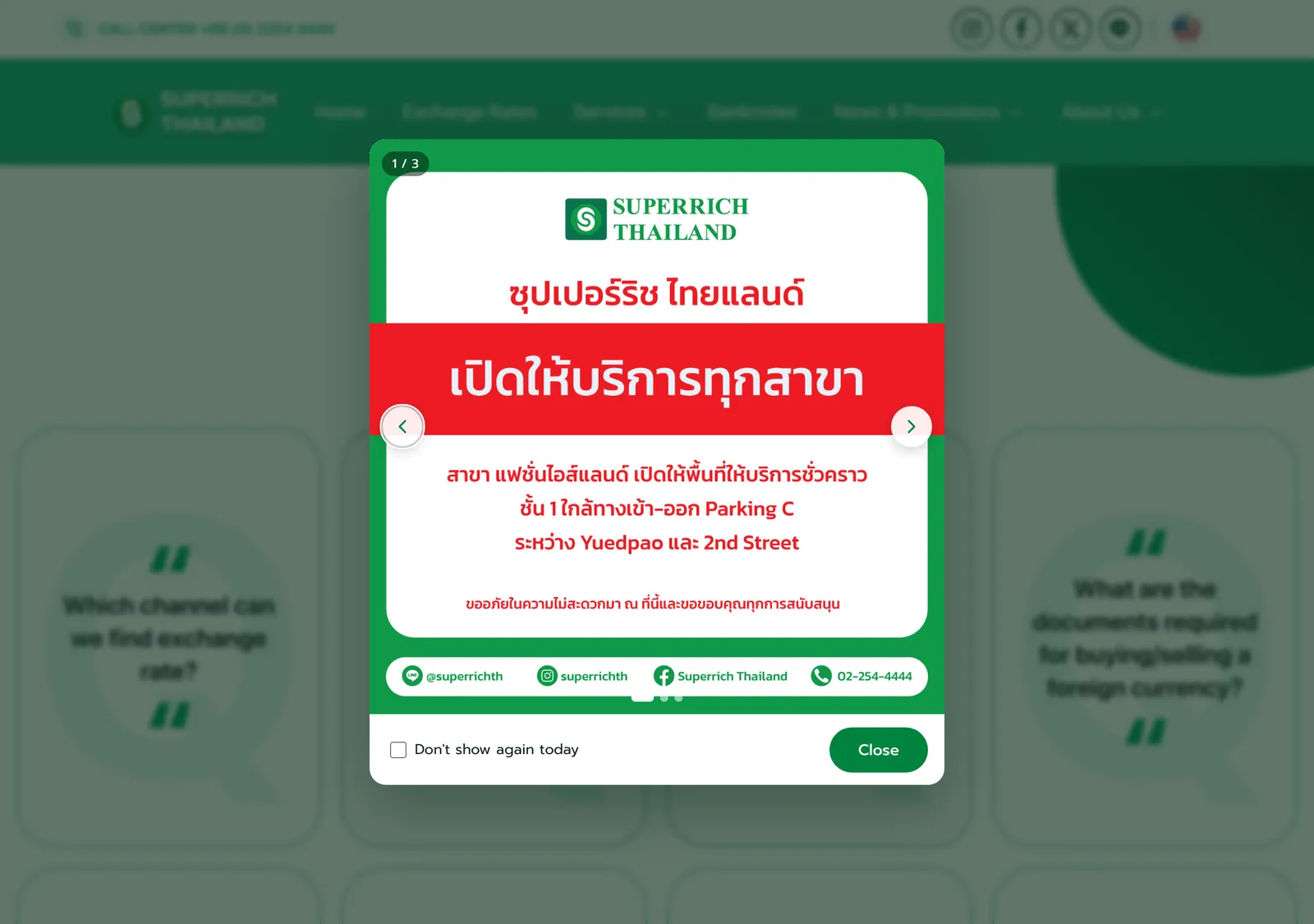
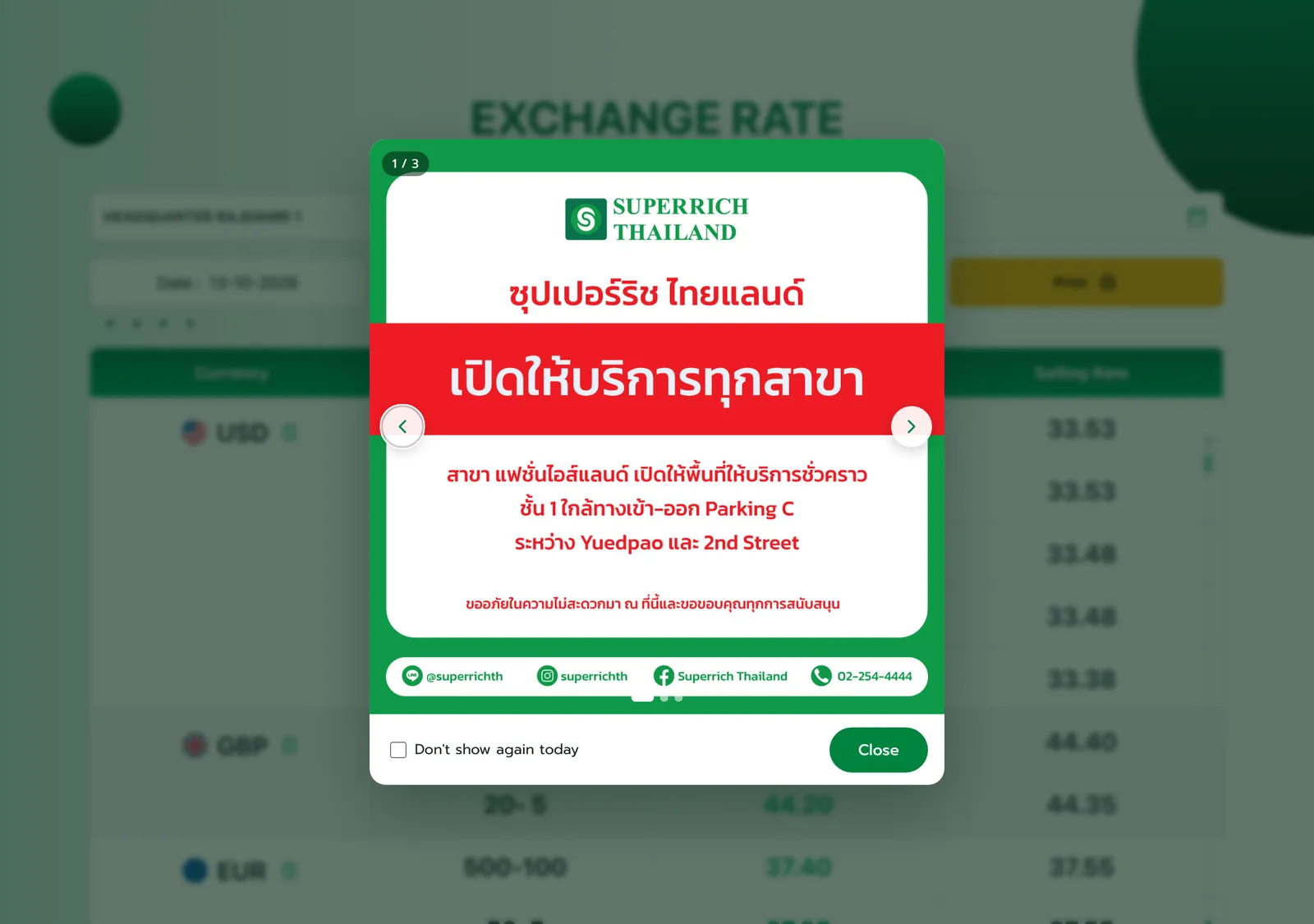
On 13 October 2026 at 17:00, the Superrich Thailand headquarters in Bangkok showed 33.48 buying and 33.53 selling for USD 100 notes. The same table showed 33.22 and 33.38 for USD 1 notes.
Who may exchange money legally
Thai rules say purchase, sale, exchange or transfer of foreign currency must be done with persons licensed by the Minister of Finance. Two kinds of business hold such a licence for cash.
Commercial banks are authorised for all types of foreign exchange transactions, including purchase and sale. Authorized money changers are non-bank companies authorised to buy and sell foreign currency banknotes.
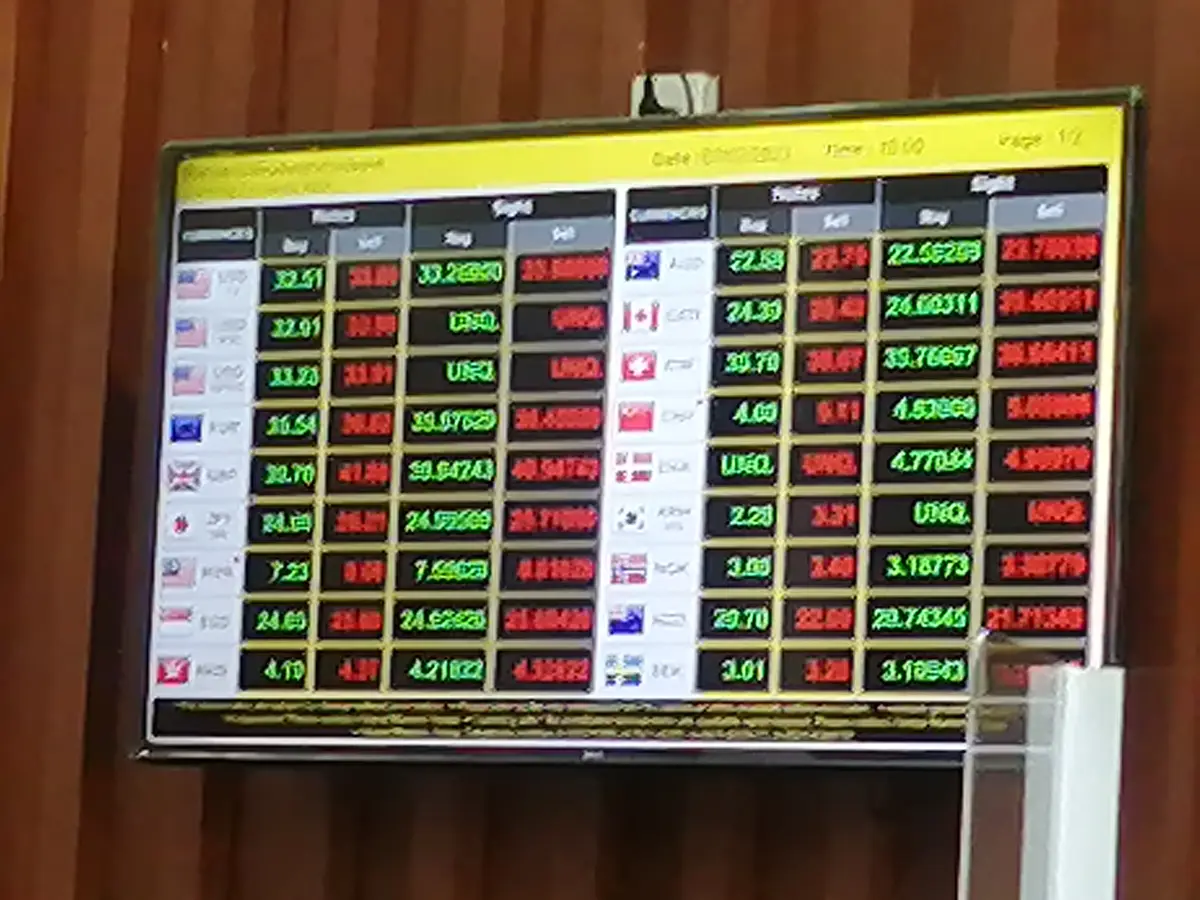
A Chiang Mai rate board
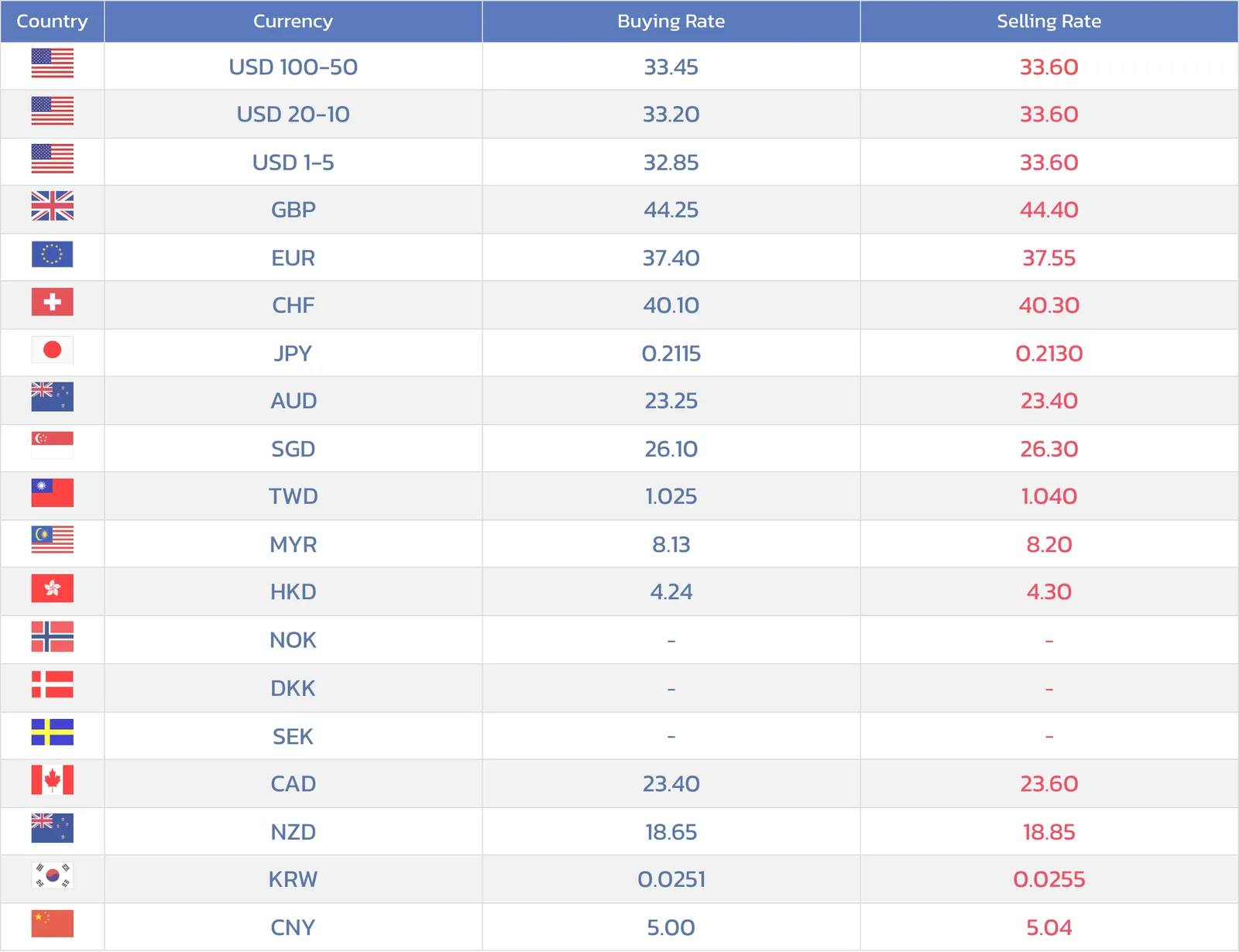
Super Money Chiangmai publishes its rate table online. On 13 October 2026 it showed 33.45 buying and 33.60 selling for USD 100 and 50 notes. USD 20 and 10 notes were 33.20 buying, and USD 1 to 5 notes were 32.85. EUR was 37.40 buying and GBP 44.25.
Its rates change at all times, so contact the business for the current figure. Treat the table as a dated example, not a quote.
There is a branch on Loi Kroh Road (ถ.ลอยเคราะห์) at 34/4. A second branch is at 25/4 Ratchawithi Road. The branch list says open every day, 8.30 to 17.30.
The contact section gives the Loi Kroh branch Monday to Friday only. Call before you go.
It is a limited partnership and shows no money-changer licence. A name that starts with “Super” is not proof of a link to Superrich Thailand, which names one location on its own page.
Reading the board
The USD 1 to 5 rate of 32.85 is lower than the 33.45 paid for USD 100 and 50 notes, so small notes lose baht on every dollar. The best buying rate is just under the Bank of Thailand interbank figure of 33.521, although the two figures are a day apart.
Bangkok Bank’s USD 50 to 100 note rate in the table below was 33.13. The same dollars bring fewer baht at that bank than at the changer’s best rate.
Booth or bank counter
Banks and authorised money changers are both licensed to buy foreign banknotes.
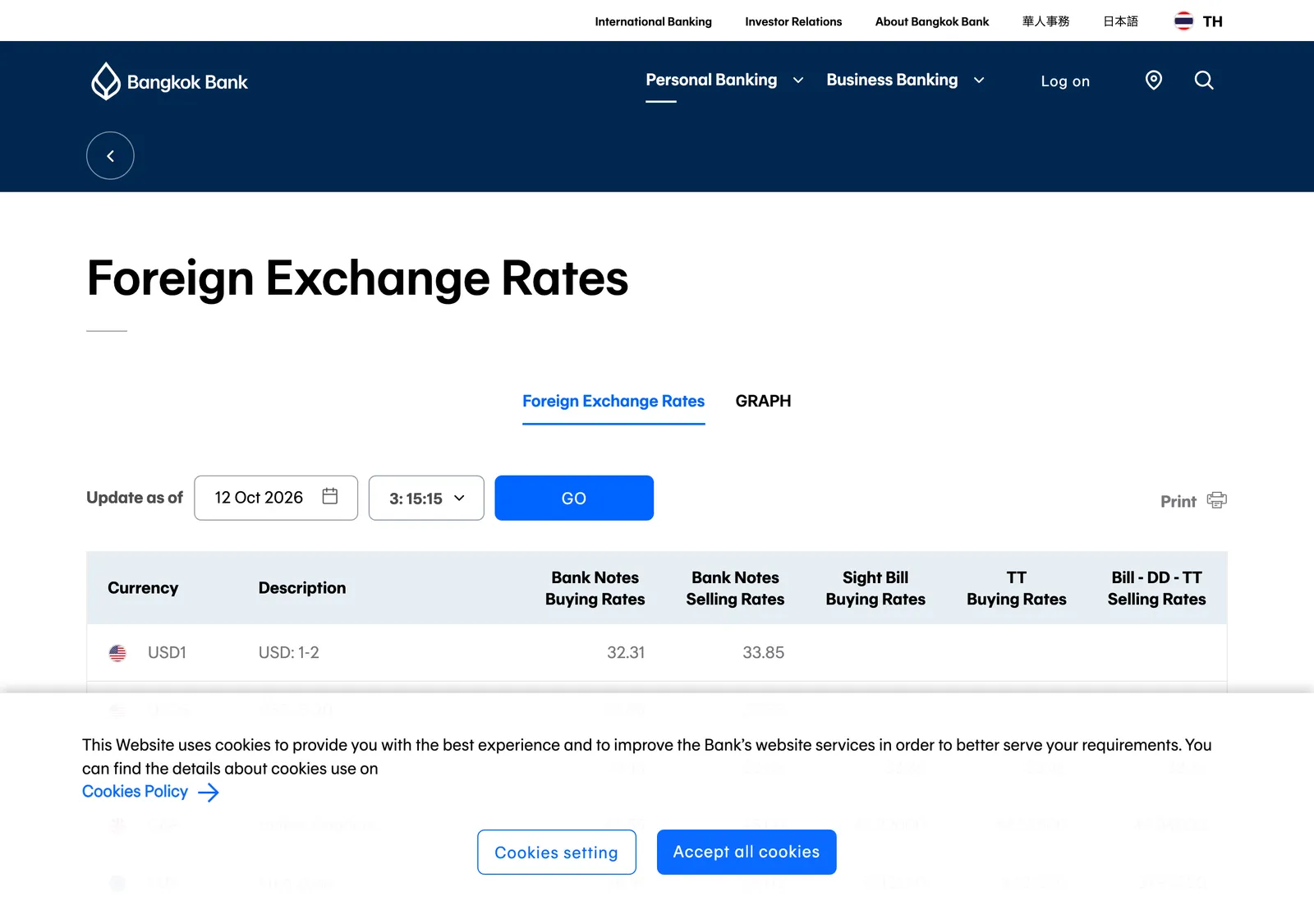
Bangkok Bank publishes a bank-note rate table by note size, for example USD 50–100 notes at 33.13 buying and 33.85 selling in the table dated 12 October 2026. Its USD 1–2 notes are 32.31 buying and 33.85 selling.
Superrich Thailand charges no commissions or fees. It does not accept coins.
What to bring
Bring a passport. Superrich Thailand takes an ID card or an unexpired passport for buying or selling foreign currency. SCB asks for an identity document such as an ID card or passport on its baht-to-foreign banknote service.
Bring banknotes, not coins, when you use Superrich Thailand.
How to compare a rate
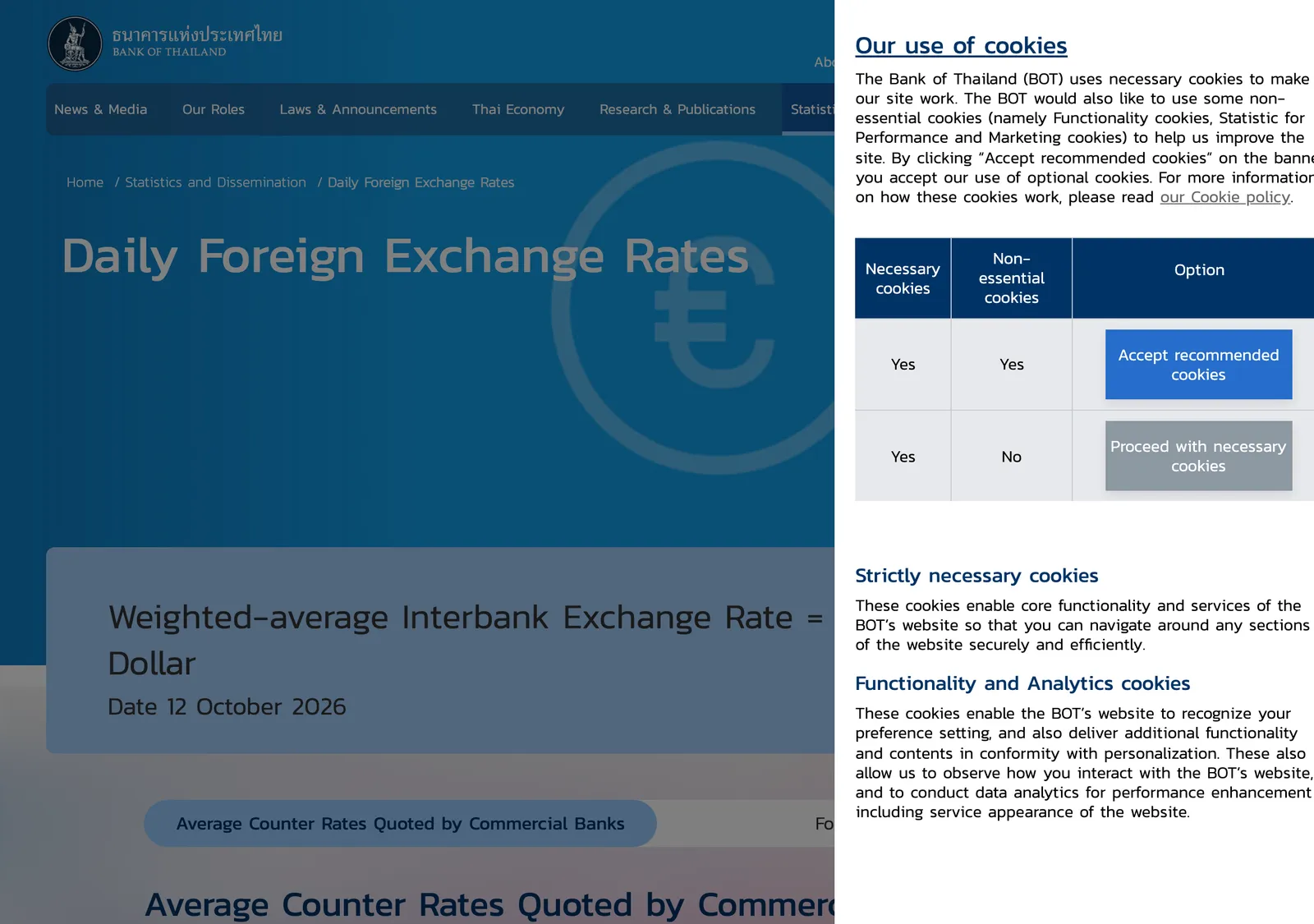
Start with a neutral figure. The Bank of Thailand published a weighted-average interbank rate of THB 33.521 per US dollar for 12 October 2026. Its page also points to thaifxrates.net for the latest rates.
Then read the operator’s buying rate for your note size. These examples are dated, and rates change during the day.
| Source, note size and time | Buying | Selling |
|---|---|---|
| Superrich Thailand, USD 100 notes, 13 Oct 2026 17:00 | 33.48 | 33.53 |
| Superrich Thailand, USD 1 notes, 13 Oct 2026 17:00 | 33.22 | 33.38 |
| Super Money Chiangmai, USD 100–50 notes, 13 Oct 2026 14:50 | 33.45 | 33.60 |
| Super Money Chiangmai, USD 1–5 notes, 13 Oct 2026 14:50 | 32.85 | 33.60 |
| Bangkok Bank, USD 50–100 notes, 12 Oct 2026 | 33.13 | 33.85 |
| Bangkok Bank, USD 1–2 notes, 12 Oct 2026 | 32.31 | 33.85 |
In every table the buying rate is higher for larger notes. Superrich Thailand’s figures are for its Rajdamri 1 headquarters in Bangkok, so a Chiang Mai board will differ.
Carrying cash in and out
Foreign currency banknotes and baht banknotes may enter Thailand without an amount limit. Foreign banknotes may leave up to the amount you purchased from authorised banks or money changers.
Baht banknotes may leave up to THB 2 million for bordering countries, Vietnam and China’s Yunnan province, and up to THB 50,000 for other countries.
A Customs declaration applies to baht banknotes above THB 450,000 or foreign currency banknotes above USD 15,000 or the equivalent, entering or leaving.
Foreign banknotes and coins may go into a foreign currency account up to the amount brought into Thailand or obtained from authorised banks or non-bank licensees. The other deposit limit is USD 15,000 per day per person.
The ATM fee comparison covers withdrawing cash instead, and the bank account guide covers opening an account.
Photo credits
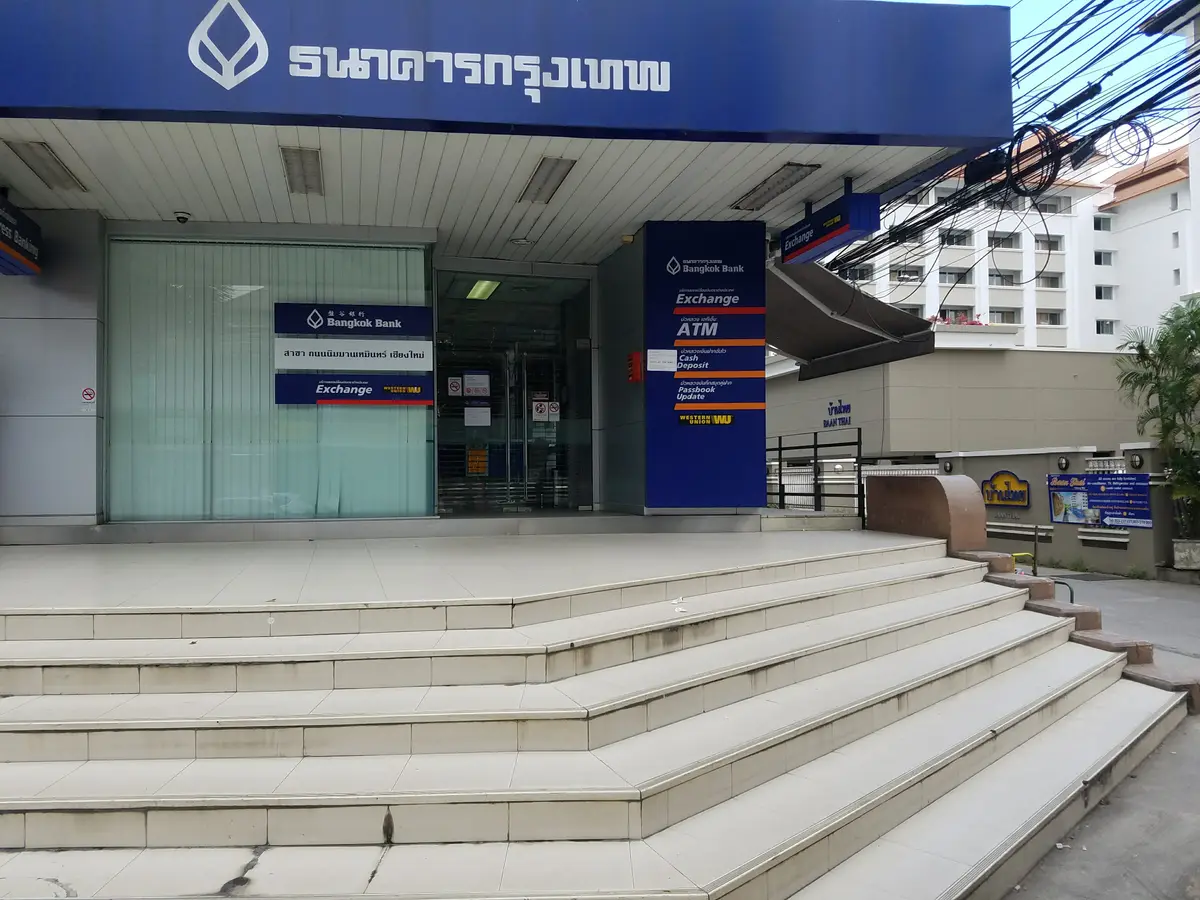
- Photos and clips uploaded to Google Maps (Krungsri Bank Tha Phae Road on Google Maps (opens in a new tab), Bangkok Bank Nimman He Min on Google Maps (opens in a new tab)) by Esteban Cuello, Dana Sutton.
Step by step
- Pick a licensed placeUse a bank, which is authorised for all foreign exchange, or an authorised money changer.
- Take your passportSuperrich Thailand takes an ID card or an unexpired passport.
- Check the Bank of Thailand figureThe interbank rate was THB 33.521 per US dollar on 12 October 2026. thaifxrates.net has the latest rates.
- Compare buying rates for your note sizeSuperrich Thailand showed 33.48 for USD 100 notes and 33.22 for USD 1 notes on 13 October 2026. Super Money Chiangmai showed 33.45 and 32.85.
- Mind the cash limitsDeclare baht banknotes above THB 450,000 or foreign banknotes above USD 15,000 at Customs.
Not confirmed: No official page read lists the licensed money changers in Chiang Mai. The Super Money Chiangmai page names no money-changer licence, so check what the booth displays. Superrich Thailand publishes only its Bangkok headquarters as a location. It is not published whether Chiang Mai bank counters ask for a passport when you sell foreign cash.
Reach readers planning life in Chiang Mai. Advertise → hello@chiangmaijao.com
Common questions
Do I need my passport to exchange money?
Superrich Thailand takes an ID card or an unexpired passport for buying or selling foreign currency. SCB asks for an identity document such as an ID card or passport on its baht-to-foreign banknote service. Carry the passport.
Who may exchange foreign currency in Thailand?
Commercial banks are authorised for all foreign exchange transactions, and authorised money changers are non-bank companies licensed to buy and sell foreign banknotes.
Does Superrich Thailand charge a fee?
It says it charges no commissions or fees. It does not exchange coins.
How much baht can I take out of Thailand?
Up to THB 2 million to bordering countries, Vietnam and China's Yunnan province, and up to THB 50,000 to other countries.
When must I declare cash at Customs?
Declare baht banknotes above THB 450,000 or foreign currency banknotes above USD 15,000 or the equivalent when entering or leaving.
How much foreign cash may I take out?
Foreign banknotes may leave up to the amount you purchased from authorised banks or money changers.
Can I put foreign cash into a bank account?
Foreign banknotes and coins may be deposited up to the amount you brought into Thailand or obtained from authorised banks or non-bank licensees. The other deposit limit is USD 15,000 per day per person.
What does a Chiang Mai changer pay for USD banknotes?
On 13 October 2026 Super Money Chiangmai showed 33.45 buying for USD 100 and 50 notes. It showed 33.20 for USD 20 and 10 notes, and 32.85 for USD 1 to 5 notes.
What do buying and selling mean on a rate board?
Buying is the rate at which the changer buys your foreign cash, so it sets how many baht you receive. Selling is the rate at which it sells foreign cash to you.
What was the Bank of Thailand's USD rate on 12 October 2026?
The weighted-average interbank rate was THB 33.521 per US dollar.
Read next
General information checked against the sources listed above, not legal advice for your situation. Rules and office practice change; confirm with the immigration office or a licensed adviser before you act. See how guides are checked.
Spotted an error? Report it.