Thailand ATM Fees for Foreign Cards: Bank-by-Bank Table
A Thai ATM charges a flat fee per withdrawal on a foreign card: THB 250 for Visa or UnionPay and THB 350 for Mastercard at Kasikornbank, Krungsri and SCB. Krung Thai Bank's English table, last revised in 2023, lists THB 220. Bangkok Bank publishes no such figure on the pages checked.
On this page
Kasikornbank, Krungsri and SCB each print a flat amount per withdrawal on a card issued abroad, and the amount depends on the card network. The table shows the figure each bank prints, not the fee your own bank adds.
Fee per withdrawal, bank by bank
Kasikornbank’s schedule is effective 22 September 2026. Krungsri’s notice is effective 11 March 2026, and its schedule effective 1 September 2026 keeps the same figures. SCB’s Mastercard notice is effective 26 March 2026. Krung Thai Bank’s English table carries revision notes up to 29 September 2023.
| Bank | Visa | Mastercard | UnionPay | JCB |
|---|---|---|---|---|
| Kasikornbank | THB 250 | THB 350 | THB 250 | No figure |
| Krungsri | THB 250 | THB 350 | THB 250 | THB 250 |
| Krung Thai Bank (2023 table) | THB 220 | THB 220 | THB 220 | No figure |
| Bangkok Bank | No figure | No figure | No figure | No figure |
| SCB | THB 250 | THB 350 | THB 250 | THB 250 |

What each bank’s schedule says
Kasikornbank
The schedule lists cash withdrawal via a K-ATM with international credit cards at THB 250 per transaction for Visa and for China UnionPay. Mastercard is THB 350 per transaction.
Krungsri
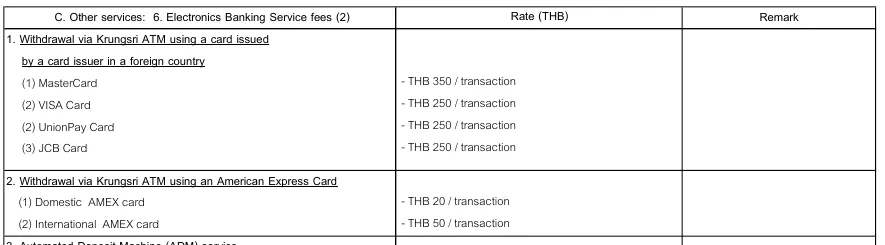
Krungsri’s notice covers withdrawal at its ATMs with a card issued by a card issuer in a foreign country. Mastercard is THB 350 per transaction, and Visa, UnionPay and JCB are THB 250. An international American Express card is THB 50 per transaction.
Krung Thai Bank
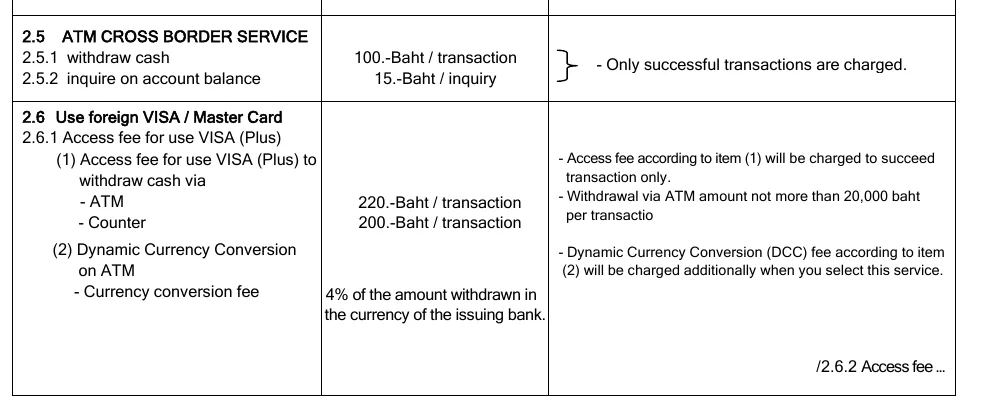
Krung Thai Bank charges an access fee of 220 baht per transaction for withdrawing cash at its ATM with a foreign VISA (Plus) or Master Card (Cirrus). Its revision notes stop at September 2023. A foreign card from a bank on the China UnionPay network carries the same 220 baht. The UnionPay access fee applies to successful transactions.
SCB
SCB’s Thai-language fee schedule lists 250 baht per transaction for a foreign-issued Visa card, with the same 250 baht for UnionPay and JCB. A foreign-issued Mastercard is 350 baht, effective 26 March 2026.
Bangkok Bank
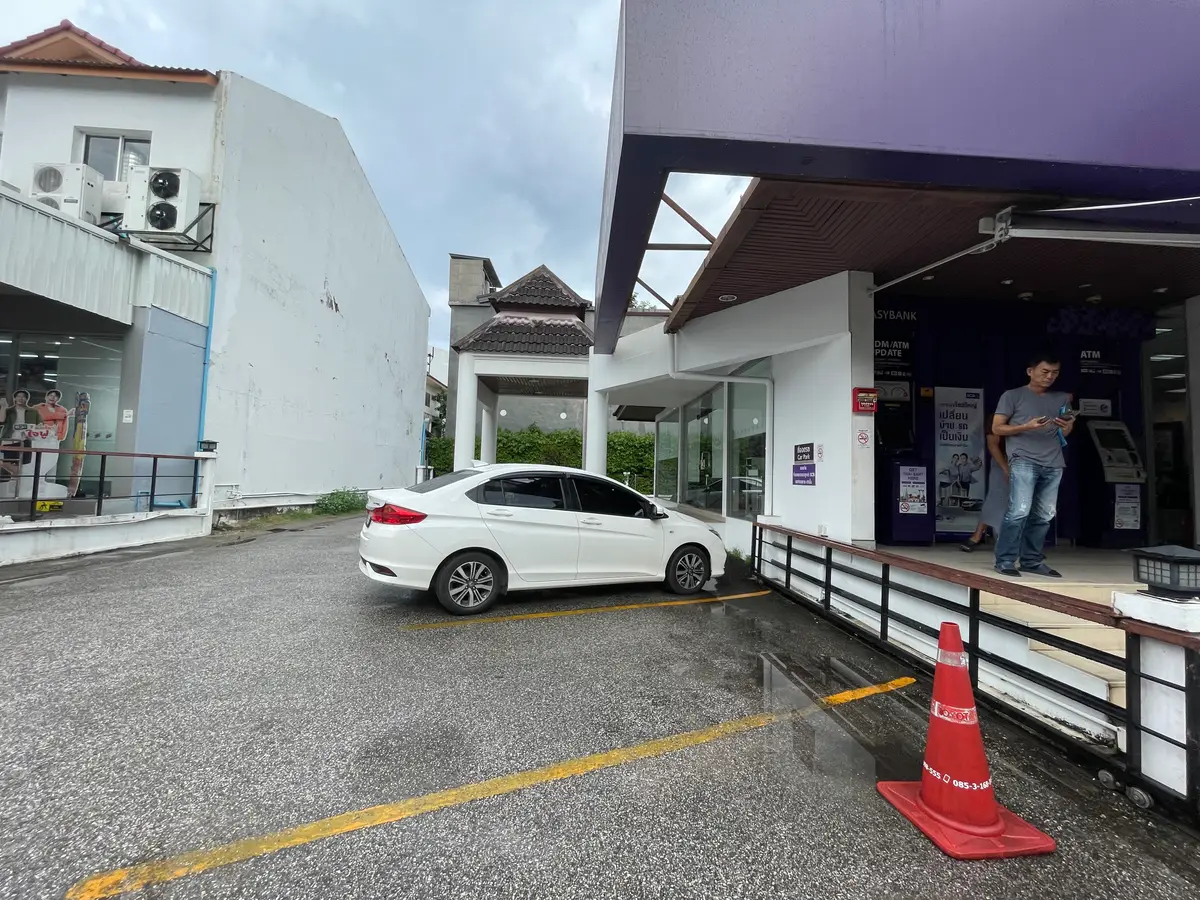
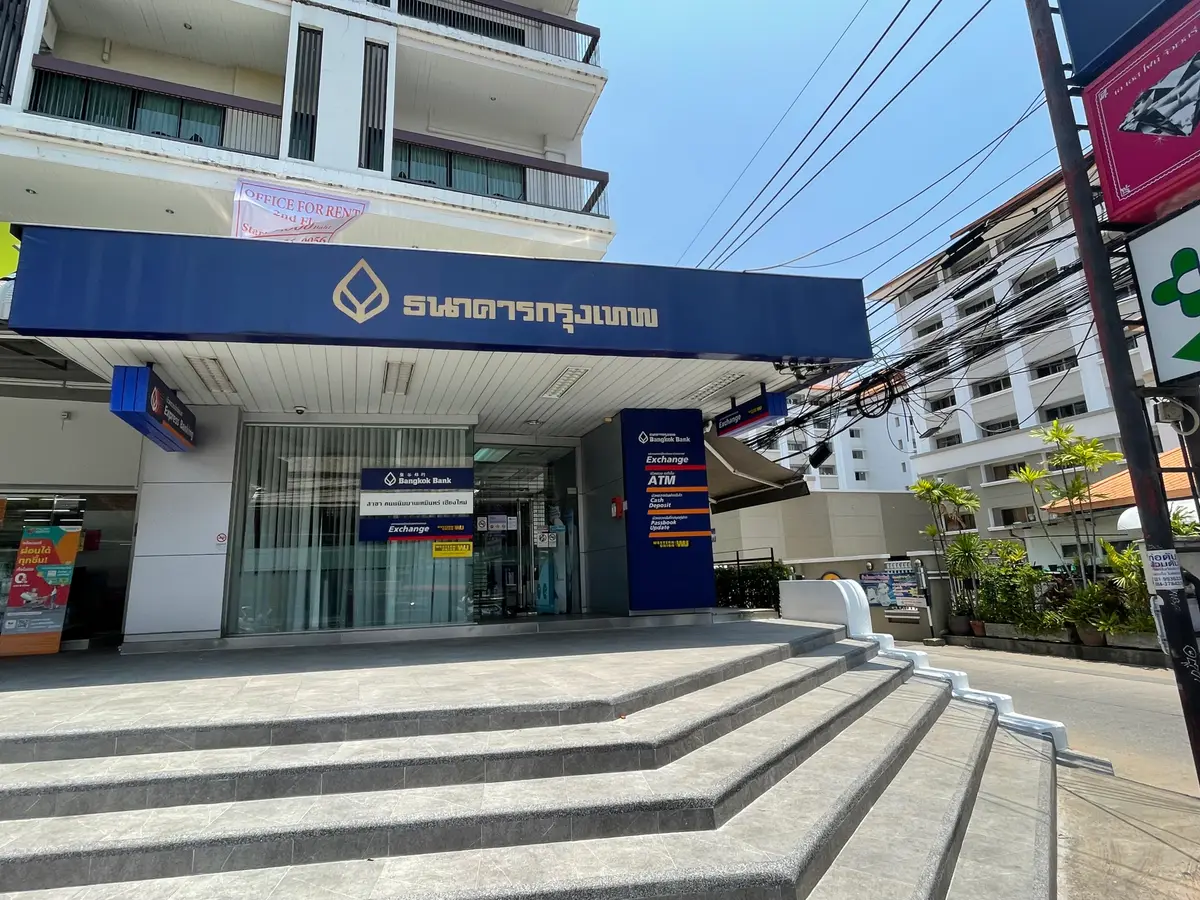
The Bangkok Bank pages checked give no figure for a foreign-issued card at its own ATMs. The table leaves those cells empty. Read the amount on the ATM screen before you confirm.
Counter or ATM
Two banks publish a counter fee for a foreign card. Krungsri charges THB 200 per transaction for an international Visa card at a branch or booth counter. Krung Thai charges 200 baht per transaction at its counter.
Krungsri’s ATM figure for Visa is THB 250. Krung Thai’s ATM figure is 220 baht.
Decline the ATM’s currency conversion
An ATM that offers to convert the withdrawal into your home currency is a currency conversion service. Krung Thai Bank charges a currency conversion fee of 4% of the amount withdrawn in the currency of the issuing bank. It charges it additionally when you select that service.
Choose the baht option at the ATM and leave the conversion to your own bank.
Ways to keep the fee down
- Take fewer, larger withdrawals: the fee is stated per transaction.
- Match the table above to the card you hold: Mastercard is THB 350 against THB 250 for Visa at three banks.
- Decline the conversion screen.
- Pay by QR where a shop offers it. Most banks waived fees on digital payments in 2018, and PromptPay registration links a bank account to a citizen ID or phone number. That covers payments, not cash withdrawals.
- Open a Thai bank account if your visa qualifies. The bank account guide covers which banks accept which visa.
For cash exchange as an alternative, see currency exchange in Chiang Mai.
Photo credits
- Photos and clips uploaded to Google Maps (Kasikornbank MAYA Chiang Mai branch on Google Maps (opens in a new tab), SCB Nimmanahaeminda on Google Maps (opens in a new tab), Bangkok Bank Nimman He Min on Google Maps (opens in a new tab)) by Nuzzer X, Khue Ho, chai jongasachat.
Not confirmed: Bangkok Bank: no fee for a foreign-issued card at its own ATMs was found, so read the ATM screen before you confirm. Krung Thai's English table carries revision notes up to 29 September 2023, so its THB 220 may have changed. Your own bank's charges are on no Thai page.
Reach readers planning life in Chiang Mai. Advertise → hello@chiangmaijao.com
Common questions
How much does a Thai ATM charge a foreign card per withdrawal?
Kasikornbank charges THB 250 for Visa or China UnionPay and THB 350 for Mastercard. Krungsri charges THB 250 for Visa, UnionPay or JCB and THB 350 for Mastercard. SCB charges 250 baht for Visa, UnionPay and JCB and 350 baht for Mastercard.
Does Mastercard cost more than Visa?
At Kasikornbank, Krungsri and SCB, yes: 350 against 250. Krung Thai Bank's 2023 table lists THB 220 for both Visa and Mastercard.
Does the fee grow with the amount I withdraw?
The figures the banks publish are stated per transaction, so one larger withdrawal pays the fee once.
Why decline the ATM's currency conversion?
Krung Thai Bank adds a currency conversion fee of 4% of the amount withdrawn when you select the conversion service.
Is a bank counter cheaper than the ATM?
Krungsri charges THB 200 per transaction for an international Visa card at the counter, against THB 250 at its ATM. Krung Thai charges THB 200 at the counter too, for any card network. No counter fee for Mastercard was found.
What do Bangkok Bank and SCB charge?
SCB charges 250 baht for Visa and 350 baht for Mastercard. Bangkok Bank charges no fee for a foreign-issued card at its own ATMs, so read the amount on the ATM screen before you confirm.
Do QR payments avoid ATM fees?
Most banks have waived fees on digital payments such as mobile payment since 2018. That note is about payments, not ATM withdrawals. PromptPay registration links an existing bank account to a citizen ID or phone number.
Read next
General information checked against the sources listed above, not legal advice for your situation. Rules and office practice change; confirm with the immigration office or a licensed adviser before you act. See how guides are checked.
Spotted an error? Report it.