DTV vs LTR vs Thailand Privilege: Which Long-Stay Visa Fits
The DTV asks for financial evidence of at least THB 500,000 and lasts 5 years, with 180 days per entry. The LTR visa lasts 10 years, with income or asset tests in US dollars. Thailand Privilege memberships run from THB 650,000 to THB 5,000,000, with no financial-proof test.
On this page
Money shown and years wanted separate these three routes. The DTV asks for financial evidence of at least THB 500,000. The LTR visa sets income or asset tests in US dollars. Thailand Privilege is a paid membership with no financial-proof test.
The three at a glance
| Route | Money test | Validity | Cost |
|---|---|---|---|
| DTV | THB 500,000 | 5 years, 180 days per entry | Set by each embassy: USD 340 and USD 400 at two posts |
| LTR | USD 80,000 a year for pensioners and remote workers | 10 years: 5 first, 5 more | THB 50,000 |
| Thailand Privilege | None | 5 to 20+ years by tier | THB 650,000 to THB 5,000,000 |
The DTV and LTR rows come from embassy and Board of Investment pages. Privilege is sold by a private company, and its fees below are from its page of February 2026.
Destination Thailand Visa (DTV)
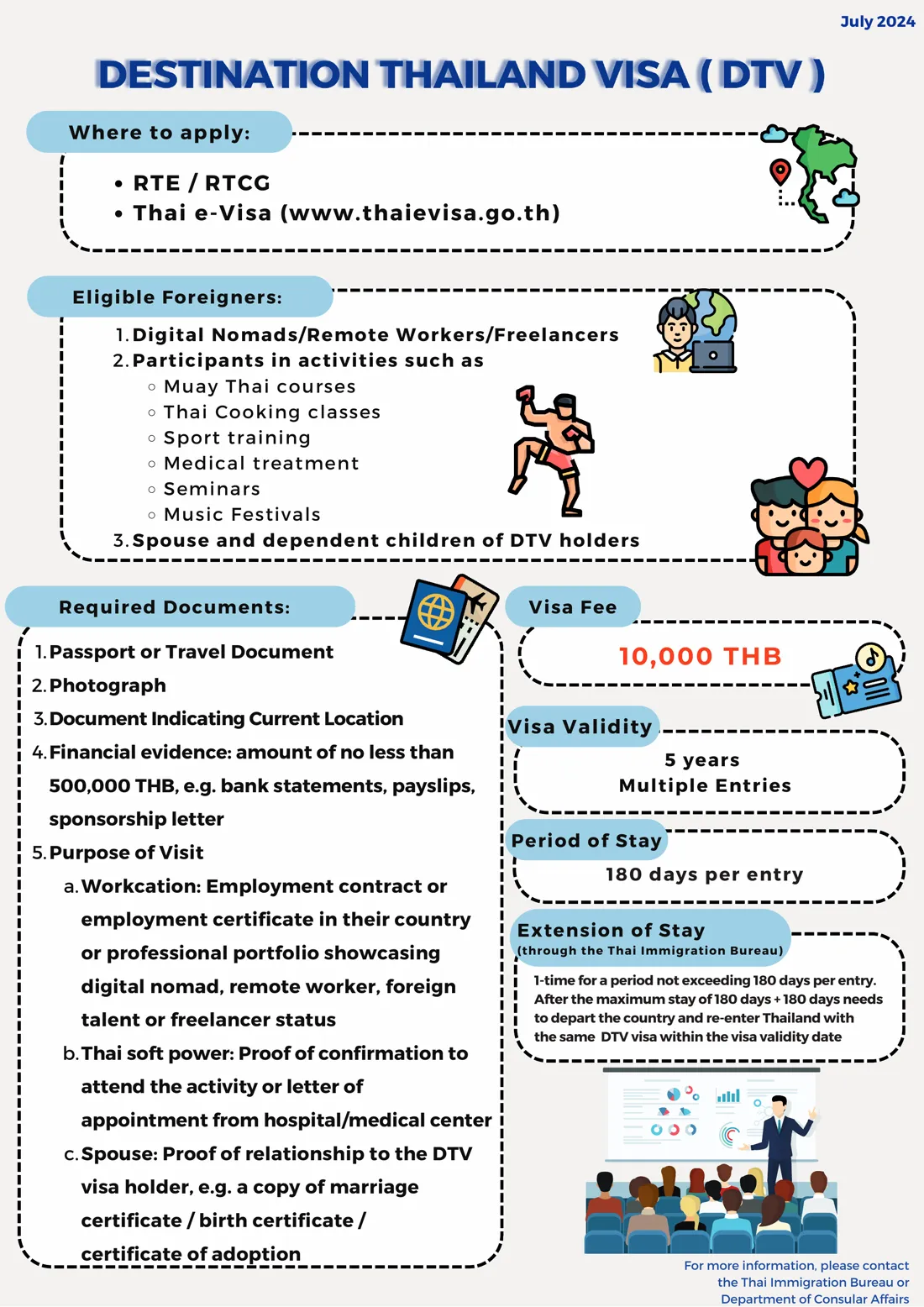
The DTV is issued to people who travel and work remotely in Thailand. It is also issued for activities such as Muay Thai courses, cooking classes and medical treatment. A spouse and children under 20 can get a DTV as accompanying family.
The visa is valid for 5 years. A holder may stay up to 180 days per entry. One extension of 180 days can be applied for at the Immigration Bureau. After that, the holder must leave and can re-enter on the same DTV within its validity.
Applications go through the Thai e-Visa platform, thaievisa.go.th. You pay the fee of the embassy that handles your application. Ho Chi Minh City charges USD 340, Washington D.C. USD 400, Berlin EUR 350, London GBP 300 and Taipei NTD 11,000.
The ministry’s July 2024 infographic shows THB 10,000 as the baseline fee, not what every embassy charges. More posts are in the per-embassy table of the DTV guide.
Money proof is the last 3 months of bank statements. Washington D.C. and Kuala Lumpur ask for an ending balance of at least THB 500,000 in each statement. Taipei words it as a minimum balance of THB 500,000. A balance of THB 500,000 or more at every point across the 3 months meets all three wordings.
Remote work is proved with an employment contract or certificate from an employer outside Thailand, or a professional portfolio for freelancers. Kuala Lumpur’s checklist dates from August 2024.
From 31 August 2026, DTV applicants submit proof of permanent residence and a criminal record certificate. The DTV guide has the fees and the extension in Chiang Mai.
Long-Term Resident (LTR) visa
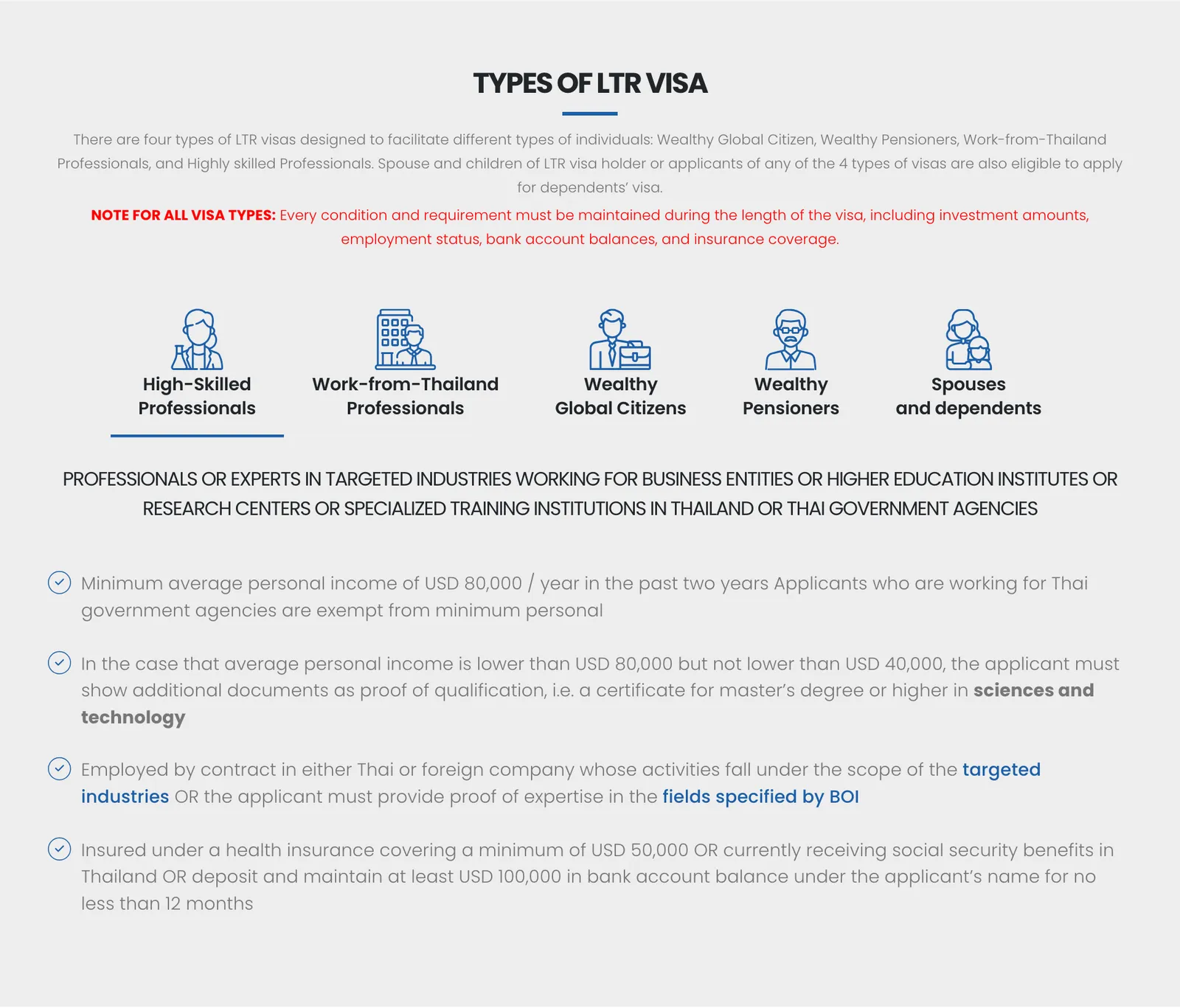
The LTR visa has four categories. It is a renewable 10-year visa: 5 years first, extendable by 5 more if the qualifications are met. LTR holders report once a year instead of every 90 days, and are exempt from re-entry permits.
- Wealthy Pensioners, aged 50 and older, need passive income of at least USD 80,000 a year. With less, but at least USD 40,000, they also invest USD 250,000.
- Work-from-Thailand Professionals need average personal income of at least USD 80,000 a year over the past two years.
- Wealthy Global Citizens hold at least USD 1 million in assets and have invested at least USD 500,000 in Thailand.
- Highly-skilled Professionals need at least 5 years of work experience in the last 10 years in the targeted industries.
All four categories need health insurance of at least USD 50,000. Social security benefits in Thailand, or a deposit of at least USD 100,000 held for no less than 12 months, also meet the test.
The Immigration Bureau fee list shows the LTR visa at THB 50,000. The BOI charges no fee for the qualification endorsement on its online system. It says results come within 20 working days.
Work, tax and family under the LTR
Work permits are not granted to Work-from-Thailand Professionals, who work remotely for a foreign employer. LTR holders working for a Thai entity pay a work-permit processing fee of THB 3,000 per year. Highly-skilled Professionals pay a 17% personal income tax rate. LTR holders get a tax exemption for overseas income.
An LTR dependant needs health insurance of at least USD 50,000, or Thai social security cover, or a deposit of at least USD 25,000. The BOI’s 2025 brochure sets no limit on the number of dependants and adds parents and legal dependants to the category.
Thailand Privilege Card (formerly Thai Elite)
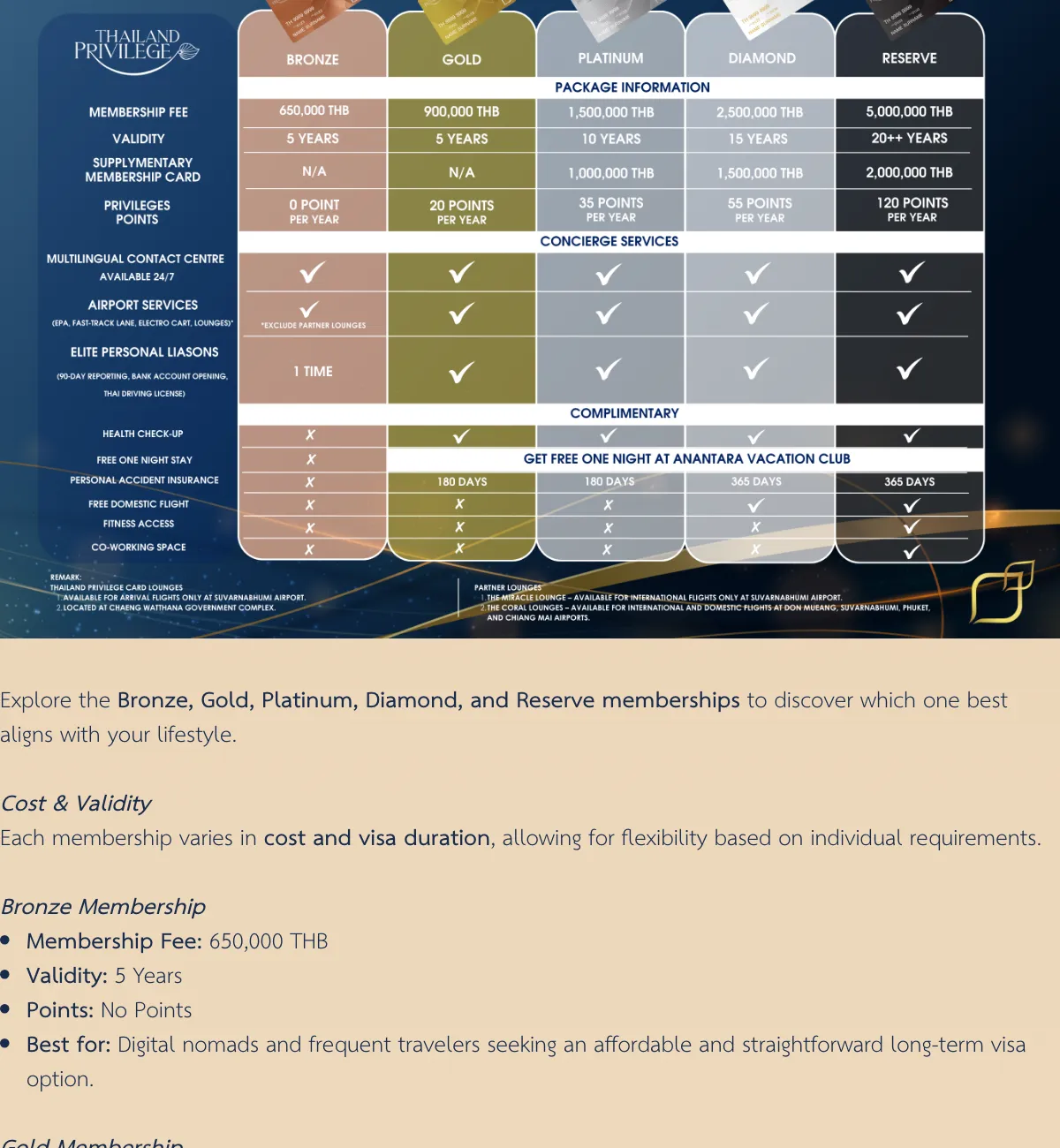
The card is the former Thai Elite Visa. The fees and validity per tier are below, from the operator’s page of February 2026.
| Tier | Fee | Validity |
|---|---|---|
| Bronze | THB 650,000 | 5 years |
| Gold | THB 900,000 | 5 years |
| Platinum | THB 1,500,000 | 10 years |
| Diamond | THB 2,500,000 | 15 years |
| Reserve | THB 5,000,000 | 20+ years |
The card is open to all foreign nationals, with no minimum age, income or employment requirements. Applications are reviewed by the Department of Consular Affairs, with approval within 2 months. The passport needs at least 1 year of validity remaining.
The visa can be affixed on arrival at international airports in Bangkok, Phuket or Chiang Mai. The personal liaison service helps with 90-day reporting, bank account opening and Thai driver’s licence assistance.
Reporting and extensions as a member
A member staying over 90 consecutive days reports to the immigration office of the residence area, on the same 90-day cycle as other foreigners.
A member’s stay extension costs THB 1,900 and can be filed 30 days in advance at the provincial immigration office of the member’s residence area. The documents include the membership card and the TM30 receipt.
Reporting, extensions and tax side by side
A foreigner permitted to stay temporarily must notify an immigration officer of their address every 90 days. Reports may be made from 15 days before until 7 days after the due date. Reporting late means reporting in person and paying a THB 2,000 fine.
For extensions, the DTV allows one extension of 180 days. The Immigration Bureau fee schedule lists THB 1,900 for an extension of stay. The LTR visa replaces the 90-day report with a yearly one.
Tax is separate from the visa. The tax residency guide explains when foreign income is taxed in Thailand.
Which one fits
If you work remotely and want multiple entries
The DTV fits: financial evidence of at least THB 500,000, 5 years of validity, and 180 days per entry. Bank accounts are the catch. Kasikornbank does not open accounts for holders of the DTV. Each bank’s rule for a DTV holder is in the bank account guide.
If you can meet a US dollar test and want 10 years
The LTR visa suits an applicant who meets one of the four categories above, at THB 50,000, with a yearly report.
If you want a purchased long stay and no income test
Thailand Privilege fits: no financial proof, at a fee from THB 650,000. Members staying over 90 consecutive days still report.
If none fit
A retirement or marriage extension is the other long-stay route. The financial proof table compares the money tests, and the marriage visa guide and retirement guide cover the two extensions.
Where each is handled in Chiang Mai
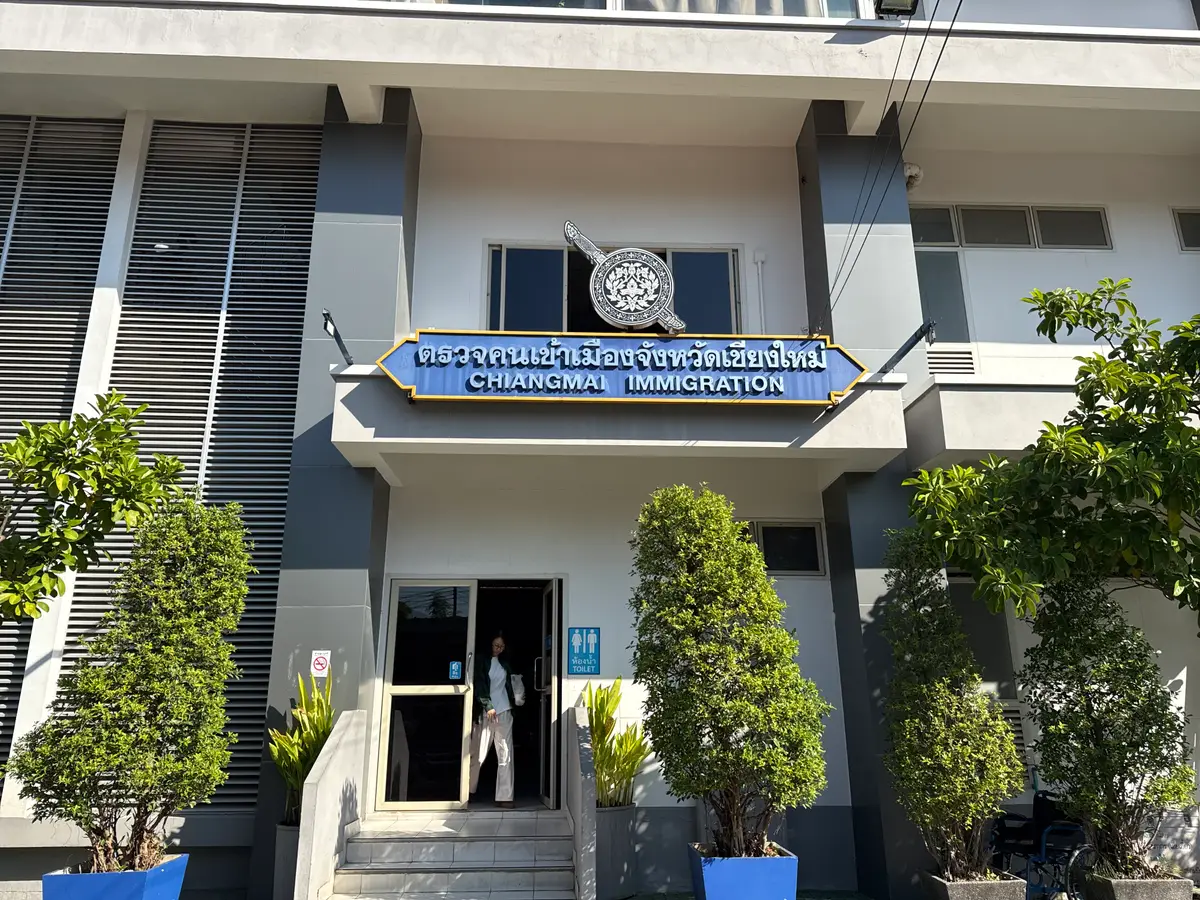
Chiang Mai Immigration is at 71 Moo 3, Sanam Bin (Airport) Road, Suthep, Mueang, Chiang Mai 50200. The telephone is 053 201 755. Its Services for Foreigner Section handles applications for and changes to all types of visa.
71 ถนนสนามบิน Suthep, Mueang Chiang Mai District, Chiang Mai 50200, Thailand · Open in Google Maps (opens in a new tab)
Open in Google Maps (opens in a new tab)
The Washington D.C. DTV holders contact the Immigration Bureau directly once in Thailand for an extension of stay.
Photo credits
- Photos and clips uploaded to Google Maps (Chiang Mai Immigration Office on Google Maps (opens in a new tab)) by Peter Miller (WHY THAI).
Not confirmed: The DTV fee in baht: embassies post fees in local currency. Privilege prices are from the operator's page of February 2026.
Reach readers planning life in Chiang Mai. Advertise → hello@chiangmaijao.com
Common questions
Which of the three costs least?
The DTV costs the least: you pay the fee of the embassy that handles your application, USD 340 at Ho Chi Minh City and USD 400 at Washington D.C.. The LTR visa fee is THB 50,000. Thailand Privilege starts at THB 650,000.
Can I work in Thailand on each of them?
Remote work for an employer or clients outside Thailand, yes: the DTV is issued for it. A job with a Thai employer needs a work permit, and working without one is punishable by prison, a fine or both. LTR Work-from-Thailand Professionals are not granted work permits; an LTR holder working for a Thai entity pays a work-permit fee of THB 3,000 per year.
Which one needs no financial proof?
Thailand Privilege requires no financial proof. The DTV asks for at least THB 500,000, and LTR categories have US dollar tests.
How long is each visa valid?
The DTV is valid for 5 years, with up to 180 days per entry. The LTR visa is 10 years, 5 first and 5 more. Privilege memberships run 5 to 20 or more years by tier.
Is Thailand Privilege the old Elite visa?
Yes, the card is the former Thai Elite Visa.
Do I have to report my address regularly?
A foreigner permitted to stay temporarily notifies an immigration officer every 90 days. LTR holders report once a year instead. Privilege members staying over 90 consecutive days report too.
Where do I extend a DTV in Chiang Mai?
DTV holders contact the Immigration Bureau. Chiang Mai Immigration handles applications for all types of visa.
Read next
General information checked against the sources listed above, not legal advice for your situation. Rules and office practice change; confirm with the immigration office or a licensed adviser before you act. See how guides are checked.
Spotted an error? Report it.